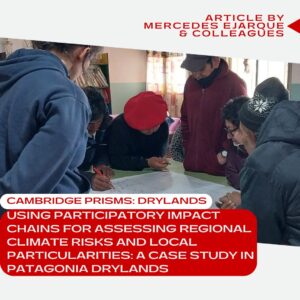
CASAS’ member Mercedes Ejarque has published with her colleagues Anabella Fantozzi, Silvina Alejandra Romano, Santiago Meza, Carla Moscardi, Rodrigo Navedo, Cesar Mario Rostagno and Almut Therburg this article in Cambridge Prisms: Drylands.
Abstract: Climate hazards impact pastoral communities due to their dependency on nature for their primary livelihoods. This study analyzes climate risk in ten pastoral livestock farming communities in Patagonia drylands of Argentina. A participatory impact chains (PICs) approach was used as a qualitative and participatory bottom-up methodology allowing for the identification and contextualization of climate hazards, exposure, intermediate impacts and vulnerability dimensions through knowledge co-production with local stakeholders. Results show that, although drought is the predominant climate hazard across the region, its impacts are heterogeneous and mediated by local socio-environmental conditions. The analysis underlines that vulnerability is not evenly distributed but is shaped by specific historical, political and environmental pathways. These findings challenge standardized top-down risk assessments, and highlight the need for adaptation strategies that are context-sensitive, territorially differentiated and that integrate local knowledge. The study also contributes to advancing qualitative participatory methodologies for climate risk assessment in pastoral systems in arid areas of Latin America, showing the regional heterogeneity and social inequalities.
Read their full article here: https://doi.org/10.1017/dry.2026.10021
CASAS

The Collective of Agrarian Scholar-Activists from the Global South (CASAS) is a community of Scholar-Activists working in critical agrarian studies.
Leave a Reply