Skip to content
Collective of Agrarian Scholar-Activists from the South

Collective of Agrarian Scholar-Activists from the South

agrarian studies, global south, scholar-activists

Menu
  • Home
  • About
  • Who is who in CASAS?
  • Resources
    • CASAS’ members publications
    • ICAS Books Series
  • Writeshops
  • Contacts
  • Network
Menu

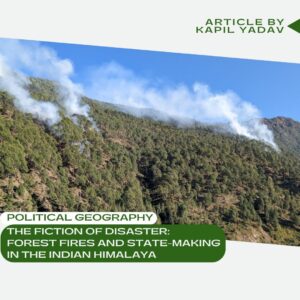
The fiction of disaster: Forest fires and state-making in the Indian Himalaya

Posted on May 23, 2026May 19, 2026 by CASAS

CASAS’ member Kapil Yadav has published this paper in Political Geography.

Abstract:

Recurrent disasters such as wildfires are increasingly attributed to anthropogenic climate change, but this broad explanation often obscures the political choices that shape how disasters are recognised, governed, and instrumentalised. Focusing on the Uttarakhand Himalaya in India, where forest fires have become a near-annual phenomenon, this article examines how disaster management is deeply entangled with state-making practices in political forests. Drawing on interviews, policy documents, and media articles, it highlights how the 2016 Uttarakhand fires marked a turning point in the formal inclusion of forest fires within India’s disaster policy. Since then, the spectacle of fire, amplified through media coverage, remote sensing technologies, and smoke spreading to distant urban centres, has helped normalise the framing of fire as a disaster. This spectacle is often disconnected from the social and ecological realities of fire in the region. It also enables the Uttarakhand Forest Department to access emergency resources, distribute blame and responsibility, and consolidate territorial control. Yet rather than reducing fire risk, disaster management interventions reinforce a suppression-oriented approach and lock the region into a firefighting trap. The study argues that disaster management in Uttarakhand is not simply a response to environmental crisis, but a political project that governs through crisis, produces risk, and deepens the state’s authority over forests. It suggests that managing wildfires as disasters can, in certain contexts, serve as a renewed site of state-making in political forests, complicating accounts of state retreat advanced in scholarship on green neoliberalism and disaster capitalism.

Read their full article here: https://doi.org/10.1016/j.polgeo.2026.103539

Follow us on our social media
  • Facebook
  • Twitter
  • Instagram

Share this:

  • Share on X (Opens in new window) X
  • Share on Facebook (Opens in new window) Facebook
  • Share on LinkedIn (Opens in new window) LinkedIn
  • Print (Opens in new window) Print

Like this:

Like Loading…

CASAS

Avatar photo

The Collective of Agrarian Scholar-Activists from the Global South (CASAS) is a community of Scholar-Activists working in critical agrarian studies.

Leave a ReplyCancel reply

RECENT POSTS

  • The fiction of disaster: Forest fires and state-making in the Indian Himalaya
  • Violent conflict, capitalism and insurgent food sovereignty
  • Does “Feminization U Hypothesis” Hold? A Discussion on Women’s Work Participation in Rural India
  • When Reformers Become Spoilers: Discretionary Implementation of Extraordinary Restitution Reform under Extractivism in Colombia
  • Mapping Fire Management: A Spatial Social Network Approach

CATEGORIES

  • Blogs
  • CASAS Members
  • CASAS' members publications
  • Multimedia
  • News
  • Resources
  • Special Issues
  • Who is who in CASAS?
  • Writeshops

ARCHIVES

  • May 2026
  • April 2026
  • March 2026
  • February 2026
  • January 2026
  • December 2025
  • November 2025
  • October 2025
  • September 2025
  • August 2025
  • July 2025
  • June 2025
  • May 2025
  • April 2025
  • March 2025
  • February 2025
  • January 2025
  • December 2024
  • November 2024
  • October 2024
  • September 2024
  • August 2024
  • July 2024
  • June 2024
  • May 2024
  • April 2024
  • March 2024
  • February 2024
  • January 2024
  • December 2023
  • November 2023
  • October 2023
  • September 2023
  • August 2023
  • July 2023
  • May 2023
  • April 2023
  • March 2023
  • February 2023
  • January 2023
  • December 2022
  • November 2022
  • October 2022
  • September 2022
  • August 2022
  • May 2022
  • February 2022
  • July 2021
  • April 2021
  • March 2021
  • February 2021
  • January 2021
  • December 2020
  • November 2020
  • October 2020
  • August 2020
  • July 2020
  • June 2020
  • May 2020
  • April 2020

RECENT COMMENTS

  1. Mercedes Ejarque on Call for applicants: Writeshop 2026
  2. shemilkalayath on Call for applicants: Writeshop 2026
  3. Why Palestine is a feminist and an anti-colonial issue  | ROAPE on Palestine: Reaffirming our commitment for a solidarity-based network of agrarian studies global-south scholars
  4. Mercedes Ejarque on Call for applicants: Writeshop 2026
  5. tranquil865a3fc7cd on Call for applicants: Writeshop 2026

TAGS

Africa Agrarian Change agribusiness agriculture Agroecology Argentina Asia authoritarianism Brazil Chile China climate change COHD Colombia conflict COVID-19 Critical Agrarian Studies Development Studies Extractivism food sovereignty gender Global South India Indonesia JPS land grabbing Land reform land rush Latin-america mexico Middle East pandemic pastoralism rural development scholar-activism Social Movements social reproduction South Africa South America sustainability Turkey Violence vulnerability writeshop Zimbabwe

CONNECT WITH CASAS

RSSTwitterFacebookLinkedin

SUSCRIBE BY EMAIL

CASAS SOUTH FACEBOOK

Tweets by Casas_South

Meta

  • Log in
  • Entries feed
  • Comments feed
  • WordPress.org
©2026 Collective of Agrarian Scholar-Activists from the South | Built using WordPress and Responsive Blogily theme by Superb
%d