Skip to content
Collective of Agrarian Scholar-Activists from the South

Collective of Agrarian Scholar-Activists from the South

agrarian studies, global south, scholar-activists

Menu
  • Home
  • About
  • Who is who in CASAS?
  • Resources
    • CASAS’ members publications
    • ICAS Books Series
  • Writeshops
  • Contacts
  • Network
Menu

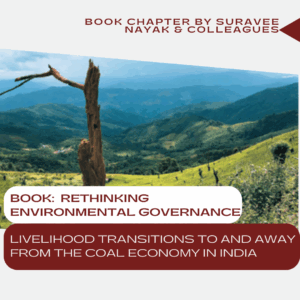
Livelihood Transitions To and Away from the Coal Economy in India

Posted on November 9, 2025October 28, 2025 by CASAS

Suravee Nayak, CASAS’ member, has published a chapter in the book “Rethinking environmental governance” with Patrik Oskarsson & Nikas Kindo.

Abstract: As coal mines expand across Central and Eastern India, rural groups typically protest against displacement and demand better compensation. Meanwhile, and often in the immediate vicinity of the expanding mines, people previously displaced but now working in the coal economy protest against mine closures. Millions across the country are situated somewhere between attempts to protect agrarian livelihoods and keeping a job in the coal economy mainly seeking to get by as their lives slowly become increasingly conflated with, and dependent on, coal. In this chapter we draw on long-term and recent engagements across two coal-producing states in India to reflect on difficult livelihood transitions to and away from coal mining. We attempt to untangle the seemingly contradictory responses of protests against new mines but also against subsequent closures years later when the coal is exhausted. We highlight coalfield conditions characterised by deep uncertainty about what the future holds, where just getting by within the informal coal economy appears the most feasible option for many. As the mines inevitably close, the livelihood transition away from coal may represent additional challenges compared to the earlier transition from farming to mining as it leaves a majority lacking assets like land or professional degrees when they yet again seek alternative livelihoods. Environmental governance policies would do well to harness the human energy and ability of millions of informal workers for more productive, equitable and sustainable outcomes.

Read the chapter here: https://library.oapen.org/handle/20.500.12657/105498

Follow us on our social media
  • Facebook
  • Twitter
  • Instagram

Share this:

  • Share on X (Opens in new window) X
  • Share on Facebook (Opens in new window) Facebook
  • Share on LinkedIn (Opens in new window) LinkedIn
  • Print (Opens in new window) Print

Like this:

Like Loading…

CASAS

Avatar photo

The Collective of Agrarian Scholar-Activists from the Global South (CASAS) is a community of Scholar-Activists working in critical agrarian studies.

Leave a ReplyCancel reply

RECENT POSTS

  • When Reformers Become Spoilers: Discretionary Implementation of Extraordinary Restitution Reform under Extractivism in Colombia
  • Mapping Fire Management: A Spatial Social Network Approach
  • Review of “Circular ecologies: environmentalism and waste politics in Urban China by Amy Zhang”
  • Digital geographies and agriculture 4.0 in the Varginha-mg intermediate geographic region: the digital divide in rural areas
  • Indigenous Pathways to Social Justice, Reconciliation, Healing and Well-being with all Our Relations

CATEGORIES

  • Blogs
  • CASAS Members
  • CASAS' members publications
  • Multimedia
  • News
  • Resources
  • Who is who in CASAS?
  • Writeshops

ARCHIVES

  • May 2026
  • April 2026
  • March 2026
  • February 2026
  • January 2026
  • December 2025
  • November 2025
  • October 2025
  • September 2025
  • August 2025
  • July 2025
  • June 2025
  • May 2025
  • April 2025
  • March 2025
  • February 2025
  • January 2025
  • December 2024
  • November 2024
  • October 2024
  • September 2024
  • August 2024
  • July 2024
  • June 2024
  • May 2024
  • April 2024
  • March 2024
  • February 2024
  • January 2024
  • December 2023
  • November 2023
  • October 2023
  • September 2023
  • August 2023
  • July 2023
  • May 2023
  • April 2023
  • March 2023
  • February 2023
  • January 2023
  • December 2022
  • November 2022
  • October 2022
  • September 2022
  • August 2022
  • May 2022
  • February 2022
  • July 2021
  • April 2021
  • March 2021
  • February 2021
  • January 2021
  • December 2020
  • November 2020
  • October 2020
  • August 2020
  • July 2020
  • June 2020
  • May 2020
  • April 2020

RECENT COMMENTS

  1. Mercedes Ejarque on Call for applicants: Writeshop 2026
  2. shemilkalayath on Call for applicants: Writeshop 2026
  3. Why Palestine is a feminist and an anti-colonial issue  | ROAPE on Palestine: Reaffirming our commitment for a solidarity-based network of agrarian studies global-south scholars
  4. Mercedes Ejarque on Call for applicants: Writeshop 2026
  5. tranquil865a3fc7cd on Call for applicants: Writeshop 2026

TAGS

Africa Agrarian Change agribusiness agriculture Agroecology Argentina Asia authoritarianism Brazil Chile China climate change COHD Colombia conflict COVID-19 Critical Agrarian Studies Development Studies Extractivism food sovereignty gender Global South India Indonesia JPS land grabbing Land reform land rush Latin-america mexico Middle East pandemic pastoralism rural development scholar-activism Social Movements social reproduction South Africa South America sustainability Turkey Violence vulnerability writeshop Zimbabwe

CONNECT WITH CASAS

RSSTwitterFacebookLinkedin

SUSCRIBE BY EMAIL

CASAS SOUTH FACEBOOK

Tweets by Casas_South

Meta

  • Log in
  • Entries feed
  • Comments feed
  • WordPress.org
©2026 Collective of Agrarian Scholar-Activists from the South | Built using WordPress and Responsive Blogily theme by Superb
%d