Skip to content
Collective of Agrarian Scholar-Activists from the South

Collective of Agrarian Scholar-Activists from the South

agrarian studies, global south, scholar-activists

Menu
  • Home
  • About
  • Who is who in CASAS?
  • Resources
    • CASAS’ members publications
    • ICAS Books Series
  • Writeshops
  • Contacts
  • Network
Menu

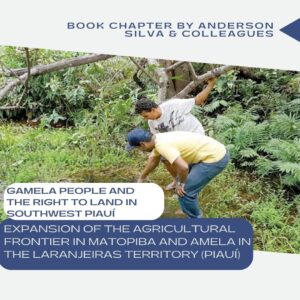
Expansion of the agricultural frontier in Matopiba and Amela in the Laranjeiras territory (Piauí)

Posted on May 13, 2024May 3, 2024 by CASAS

Anderson Silva, a member of CASAS, and colleagues have recently published their latest book chapter on the Sustainable Futures Collaborative website.

Abstract:

The book chapter discusses the expansion of agricultural frontiers in the Matopiba region and the r-existence (historical resistance) of the Akroá Gamela people in the Laranjeiras territory of South Piauí, Brazil. It highlights the historical struggle of the indigenous people against the encroachment of agribusiness, emphasizing their fight for territorial recognition, land demarcation, and conservation of their way of life of the environmental destruction. The term “r-existence” is used to denote the indigenous people’s historical existence in the territory before the arrival of agribusiness. The text provides a detailed account of the expansion of the agricultural frontier in the Matopiba region, the significant impact on the Cerrado biome, and the socio-economic implications. It presents data on the deforestation in the Cerrado biome, ranking the states that have contributed to deforestation, with Piauí being the occupies seventh position. The narrative also delves into the historical context of the occupation of the Cerrado, the government incentives for agribusiness expansion, and the challenges faced by traditional communities, particularly the Akroá Gamela people, due to the intensification of soybean production and expansion of the agricultural frontier. Furthermore, the document sheds light on the struggles and r-existence of the Akroá Gamela people, emphasizing their fight for recognition, land demarcation, and protection of the environment. It highlights the creation of the Association of Traditional and Indigenous Peoples of the Laranjeiras Community (APIGL) in 2021, marking a significant step in defending the territory and advocating for land recognition and demarcation. The narrative also emphasizes the community’s efforts to protect their land, combat environmental destruction, and secure their rights through collective action and the creation of the association. In conclusion, the document underscores the ongoing challenges faced by the Akroá Gamela people in their fight for territorial rights, environmental protection, and cultural preservation. It emphasizes the significance of the from the Akroá Gamela Association in legitimizing their ethnic struggle for land and environmental protection, as well as the need for state intervention to fulfill constitutional obligations in land demarcation and indigenous rights protection.

You can access the full book chapter, and the full book, all in Portuguese, by clicking here.

Follow us on our social media
  • Facebook
  • Twitter
  • Instagram

Share this:

  • Share on X (Opens in new window) X
  • Share on Facebook (Opens in new window) Facebook
  • Share on LinkedIn (Opens in new window) LinkedIn
  • Print (Opens in new window) Print

Like this:

Like Loading…

CASAS

Avatar photo

The Collective of Agrarian Scholar-Activists from the Global South (CASAS) is a community of Scholar-Activists working in critical agrarian studies.

Leave a ReplyCancel reply

RECENT POSTS

  • When Reformers Become Spoilers: Discretionary Implementation of Extraordinary Restitution Reform under Extractivism in Colombia
  • Mapping Fire Management: A Spatial Social Network Approach
  • Review of “Circular ecologies: environmentalism and waste politics in Urban China by Amy Zhang”
  • Digital geographies and agriculture 4.0 in the Varginha-mg intermediate geographic region: the digital divide in rural areas
  • Indigenous Pathways to Social Justice, Reconciliation, Healing and Well-being with all Our Relations

CATEGORIES

  • Blogs
  • CASAS Members
  • CASAS' members publications
  • Multimedia
  • News
  • Resources
  • Who is who in CASAS?
  • Writeshops

ARCHIVES

  • May 2026
  • April 2026
  • March 2026
  • February 2026
  • January 2026
  • December 2025
  • November 2025
  • October 2025
  • September 2025
  • August 2025
  • July 2025
  • June 2025
  • May 2025
  • April 2025
  • March 2025
  • February 2025
  • January 2025
  • December 2024
  • November 2024
  • October 2024
  • September 2024
  • August 2024
  • July 2024
  • June 2024
  • May 2024
  • April 2024
  • March 2024
  • February 2024
  • January 2024
  • December 2023
  • November 2023
  • October 2023
  • September 2023
  • August 2023
  • July 2023
  • May 2023
  • April 2023
  • March 2023
  • February 2023
  • January 2023
  • December 2022
  • November 2022
  • October 2022
  • September 2022
  • August 2022
  • May 2022
  • February 2022
  • July 2021
  • April 2021
  • March 2021
  • February 2021
  • January 2021
  • December 2020
  • November 2020
  • October 2020
  • August 2020
  • July 2020
  • June 2020
  • May 2020
  • April 2020

RECENT COMMENTS

  1. Mercedes Ejarque on Call for applicants: Writeshop 2026
  2. shemilkalayath on Call for applicants: Writeshop 2026
  3. Why Palestine is a feminist and an anti-colonial issue  | ROAPE on Palestine: Reaffirming our commitment for a solidarity-based network of agrarian studies global-south scholars
  4. Mercedes Ejarque on Call for applicants: Writeshop 2026
  5. tranquil865a3fc7cd on Call for applicants: Writeshop 2026

TAGS

Africa Agrarian Change agribusiness agriculture Agroecology Argentina Asia authoritarianism Brazil Chile China climate change COHD Colombia conflict COVID-19 Critical Agrarian Studies Development Studies Extractivism food sovereignty gender Global South India Indonesia JPS land grabbing Land reform land rush Latin-america mexico Middle East pandemic pastoralism rural development scholar-activism Social Movements social reproduction South Africa South America sustainability Turkey Violence vulnerability writeshop Zimbabwe

CONNECT WITH CASAS

RSSTwitterFacebookLinkedin

SUSCRIBE BY EMAIL

CASAS SOUTH FACEBOOK

Tweets by Casas_South

Meta

  • Log in
  • Entries feed
  • Comments feed
  • WordPress.org
©2026 Collective of Agrarian Scholar-Activists from the South | Built using WordPress and Responsive Blogily theme by Superb
%d