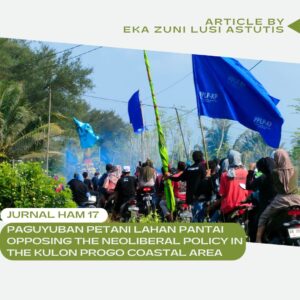
CASAS’ member Eka Zuni Lusi Astuti has published this article in Jurnal HAM 17.
Abstract:
The Government of Kulon Progo Regency and Jogja Magasa Iron, Ltd. announced its sand iron mining plan to the coastal community in Kulon Progo, Yogyakarta in 2006. The coastal farmers refused the plan due to the loss of agricultural land required for mining, as well as its subsequent impacts on the environment and livelihoods and established Paguyuban Petani Lahan Pantai (PPLP) or the “Coastal Farmers Union” to fight the government’s mining plan. The PPLP developed social movements in the coastal areas through rallies, information campaigns, and networking with national and international NGOs. In 2014, the government postponed the mining plan, the future of which remained unclear today. From the initial rejection of the mining proposal, the resistance movement expanded to resist all forms of policy involving coastal land grabbing. The article argues that PPLP’s resistance is a reaction to extractivism developed by the state and public sector. The issue reflects the fifth premise of Harvey’s accumulation by dispossession theory, that accumulation by dispossession encourages struggles. The Indonesian political economy set up the extractivism process that occurred in the context of the sand iron mining plan in Kulon Progo. The mining plan is part of a land grabbing process that provokes the PPLP resistance movement. This study aims to describe the struggle of the PPLP to sustain the coastal land as coastal farming over the neoliberal policy related to mining plans.
Read their full paper here: https://doi.org/10.30641/ham.2026.17.53-66
CASAS

The Collective of Agrarian Scholar-Activists from the Global South (CASAS) is a community of Scholar-Activists working in critical agrarian studies.
Leave a Reply