CASAS is a self-organised network of scholar-activists from the Global South working in agrarian studies. It emerged from the 2019 Journal of Peasant Studies Writeshop on Critical Agrarian Studies and Scholar-Activism in Beijing and has since expanded through subsequent editions. The network is run by its participants, who coordinate its activities collectively to establish a politically engaged, solidarity-based network of agrarian studies for Global South scholars
We approach the Global South not as a fixed geography, but as a critical framework shaped by power struggles and inequalities. While the term commonly refers to countries in Africa, Asia, and Latin America, we also encompass the marginalisation and systemic barriers working-class scholars, migrants, women, Indigenous peoples, and other groups face within the Global North. At the same time, we critique the idea of a homogenous South: knowledge production in these regions is often shaped by colonial and capitalist hierarchies, reinforcing class divisions and injustice. For us, the Global South is a political and analytical position rooted in intersectional struggles, one that challenges binary North–South divides and foregrounds solidarity, positionality, and resistance in agrarian scholarship and activism.

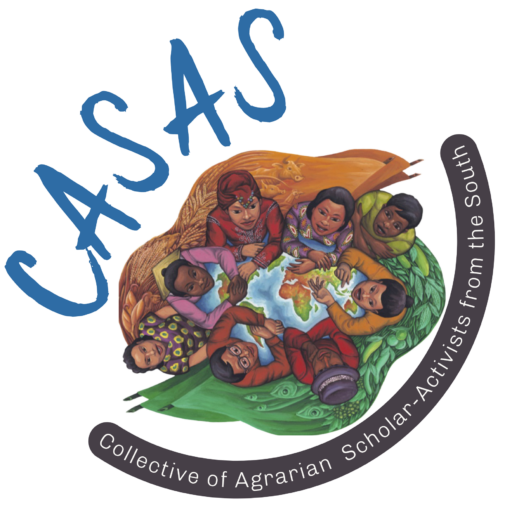
CASAS’ art is made by Federico ‘Boy’ Dominguez (BoyD), who has been creating the cover art for JPS since 2009. The artwork on CASAS’ website depicts the solidarity of scholar-activists from the South, who are held together in a seed pod. The scholar-activists symbolise seeds that will be scattered across the world, taking root and flourishing wherever they land.
BoyD is a Filipino activist painter and musician who belongs to the Mandaya indigenous peoples in Mindanao, in the southern Philippines. For decades, BoyD has painted, in his distinct style, images of political struggles to dismantle structures of exploitation, oppression and extractivism, and to construct alternatives such as food sovereignty and agroecology.
CASAS promotes scholarship and activism in critical agrarian studies and alternative ways of navigating the structural barriers in academia by following principles of solidarity and mutual care. Our research agenda investigates evolving agrarian questions, land and water grabs, food and seed sovereignty, environmental and climate justice, territorial defence, and rural transformations—while avoiding the essentialisation of communities and striving to expand critical agrarian studies beyond university walls through accountable, socially transformative scholarship.
Learn more about CASAS by browsing our webpage:
And don’t forget to follow us on social media!
You must be logged in to post a comment.