Skip to content
Collective of Agrarian Scholar-Activists from the South
Menu
  • Home
  • About
  • Who is who in CASAS?
  • Resources
    • CASAS’ members publications
    • ICAS Books Series
  • Writeshops
  • Contacts
  • Network
Menu

Designing Gender-Responsive Climate Information Services: Insights from Evidence

Posted on April 17, 2026April 14, 2026 by CASAS

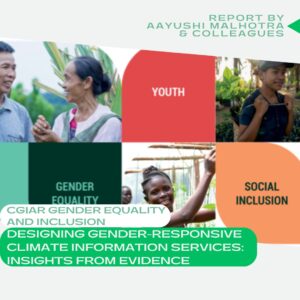
Aayushi Malhotra (CASAS’ member) has published this report in the series CGIAR Gender Equality and Inclusion with Gerald Katothya, Ranjitha Puskur and Niyati Singaraju.

Abstract: The CGIAR Gender Equality and Inclusion (GEI) Accelerator enables transformative research on gender in agriculture and food systems, promoting equitable, sustainable, productive and climate-resilient outcomes. The Accelerator prioritizes the generation of high-quality evidence, development of innovative methods and tools, and creation of strategic alliances that drive systemic change toward inclusive food systems within planetary boundaries. Within the Accelerator, the Sub-Area of Work (AoW) on “Evidence to Policy”, led by the International Rice Research Institute (IRRI), focuses on leveraging evidence, strategic communication and engagement to inform policy and practice. It synthesizes and disseminates robust evidence, identifies gaps and addresses emerging questions related to gender in agriculture and food systems. In this context, two complementary studies and a multi-stakeholder workshop were conducted in 2024 to strengthen the evidence base on the gender responsiveness of climate information services (CIS) in agrifood systems and to distil lessons from relevant experiences across low- and middle-income countries (LMICs). Reliable and timely access to climate information can significantly enhance adaptation and mitigation efforts in response to climate change (Coulibaly et al. 2015; UNDP 2019; Warner et al. 2022). However, many farmers—especially women and those from socially or economically marginalized groups—face structural barriers that limit their ability to access, interpret, and act on CIS (McOmber et al. 2013). Gender-specific differences in access, needs, preferences, and use of CIS are frequently overlooked in service design and delivery (Ngigi & Muange 2022; Bryan et al. 2024). Women often require distinct communication channels, trusted social networks, and tailored capacity support to fully benefit from CIS (Raj et al. 2020). Failing to consider these gendered dimensions can exacerbate inequalities and increase women’s vulnerability to climate risks within agrifood systems. This report consolidates findings from the three-part study that builds sequentially across complementary evidence streams:
*Landscape mapping: This component maps the CIS provision landscape in agrifood systems across LMICs. It examines the state of climate data infrastructure; the types and content of agrometeorological information and advisories (e.g., meteorological variables, forecast horizons, sectoral focus); the communication channels and formats used; and the institutional actors involved in CIS production and dissemination.
*Scoping review: The second component synthesizes existing evidence on gendered access to and usability of CIS, with a focus on the barriers faced by women farmers and the design and delivery features that make CIS more gender-responsive.
*Stakeholder consultation workshop: The third component engaged researchers, practitioners and service providers in reflecting on the study findings and identifying strategies for closing evidence and implementation gaps. Together, these components aim to inform the design of gender-responsive CIS that can better reach, serv, and benefit women farmers through tailored information, participatory design and complementary support.

Read their report here: https://hdl.handle.net/10568/181376

Follow us on our social media
  • Facebook
  • Twitter
  • Instagram

Share this:

  • Twitter
  • Facebook
  • LinkedIn
  • Print

Like this:

Like Loading...

CASAS

Avatar photo

The Collective of Agrarian Scholar-Activists from the Global South (CASAS) is a community of Scholar-Activists working in critical agrarian studies.

Leave a ReplyCancel reply

Recent Posts

  • Who is who in CASAS? Kunal Munjal
  • From anti-reflexive politicization to anti-reflexive policies: The emergence of renewable exclusion zones in United States environmental policy
  • Designing Gender-Responsive Climate Information Services: Insights from Evidence
  • Using participatory impact chains for assessing regional climate risks and local particularities: A case study in Patagonia drylands
  • Who is who in CASAS? Enrique Castañón Ballivián

Categories

  • Blogs (154)
  • CASAS Members (40)
  • Multimedia (4)
  • News (184)
  • Resources (277)
    • CASAS' members publications (252)
  • Who is who in CASAS? (39)
  • Writeshops (9)

Archives

  • April 2026 (10)
  • March 2026 (12)
  • February 2026 (7)
  • January 2026 (11)
  • December 2025 (7)
  • November 2025 (12)
  • October 2025 (9)
  • September 2025 (9)
  • August 2025 (7)
  • July 2025 (7)
  • June 2025 (9)
  • May 2025 (13)
  • April 2025 (7)
  • March 2025 (12)
  • February 2025 (15)
  • January 2025 (12)
  • December 2024 (10)
  • November 2024 (7)
  • October 2024 (8)
  • September 2024 (8)
  • August 2024 (8)
  • July 2024 (9)
  • June 2024 (8)
  • May 2024 (12)
  • April 2024 (5)
  • March 2024 (7)
  • February 2024 (9)
  • January 2024 (3)
  • December 2023 (13)
  • November 2023 (4)
  • October 2023 (3)
  • September 2023 (14)
  • August 2023 (2)
  • July 2023 (12)
  • May 2023 (5)
  • April 2023 (9)
  • March 2023 (5)
  • February 2023 (10)
  • January 2023 (7)
  • December 2022 (2)
  • November 2022 (7)
  • October 2022 (3)
  • September 2022 (2)
  • August 2022 (3)
  • May 2022 (2)
  • February 2022 (1)
  • July 2021 (2)
  • April 2021 (3)
  • March 2021 (3)
  • February 2021 (2)
  • January 2021 (1)
  • December 2020 (1)
  • November 2020 (4)
  • October 2020 (3)
  • August 2020 (4)
  • July 2020 (1)
  • June 2020 (3)
  • May 2020 (4)
  • April 2020 (5)

Recent Comments

  • Mercedes Ejarque on Call for applicants: Writeshop 2026
  • shemilkalayath on Call for applicants: Writeshop 2026
  • Why Palestine is a feminist and an anti-colonial issue  | ROAPE on Palestine: Reaffirming our commitment for a solidarity-based network of agrarian studies global-south scholars
  • Mercedes Ejarque on Call for applicants: Writeshop 2026
  • tranquil865a3fc7cd on Call for applicants: Writeshop 2026

Tags

Africa Agrarian Change agribusiness agriculture Agroecology Argentina Asia authoritarianism Brazil Chile China climate change COHD Colombia conflict COVID-19 Critical Agrarian Studies Development Studies Extractivism food sovereignty gender Global South India Indonesia JPS land grabbing Land reform land rush Latin-america mexico Middle East pandemic pastoralism rural development scholar-activism Social Movements social reproduction South Africa South America sustainability Turkey Violence vulnerability writeshop Zimbabwe

Connect with CASASouth

RSSTwitterFacebook

Subscribe to CASASOUTH by Email

Subscribe to casasouth.org by Email

CASASouth Facebook

CASASouth Facebook
Tweets by Casas_South

Meta

  • Log in
  • Entries feed
  • Comments feed
  • WordPress.org
©2026 Collective of Agrarian Scholar-Activists from the South | Built using WordPress and Responsive Blogily theme by Superb
%d