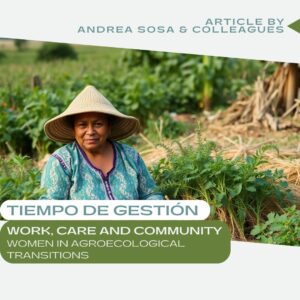
CASAS’ member Andrea Sosa has published this article in Spanish with Daiana Perez & Mariana Palumbo in Tiempo de gestión.
Abstract: In this article, we delve into the intricate dynamics of the contributions made by cisgender women within the family farming sector to agroecological transition processes. Our exploration commences by dissecting and critically examining the concept of the triple workday, encompassing its spheres of productivity, reproductive/care responsibilities, and community engagement. The latter entails active involvement in institutional, organizational, and territorial endeavors. We approach agroecology from its multifaceted perspective, recognizing it as a scientific discipline, a practical approach, and a social movement. This academic, socio-political, and socio-productive framework embracing diverse elements of traditional agriculture has garnered increased significance and legitimacy over the past five decades in reshaping rural landscapes and societies. The expansive nature of this paradigm enables to reevaluate socio-productive processes through a myriad of interdisciplinary lenses. Our specific focus lies in probing the intricate social relations engendered within agroecological praxis, drawing insights from feminist studies on labor dynamics. To do so, we used a qualitative methodology that combined semi-structured interviews, participant observation, and long-term monitoring of women’s work. We concluded that agroecology redefines women’s work and generates new responsibilities as well as new identities in their work.
Read their full article in Spanish here: https://revista.uader.edu.ar/index.php/tg/article/view/304
CASAS

The Collective of Agrarian Scholar-Activists from the Global South (CASAS) is a community of Scholar-Activists working in critical agrarian studies.
Leave a Reply