Skip to content
Collective of Agrarian Scholar-Activists from the South

Collective of Agrarian Scholar-Activists from the South

agrarian studies, global south, scholar-activists

Menu
  • Home
  • About
    • About CASAS
    • CASAS Manifesto
    • Position paper: transforming critical agrarian studies
  • Members
    • Who is who in CASAS?
  • Our Work
    • CASAS’ members publications
    • Special Issues
      • JPS Food Sovereignty
    • Conferences
  • Resources
    • News
    • Insights from the ground
    • Multimedia
    • JPS Writeshop
    • ICAS Books Series
  • Contact
Menu

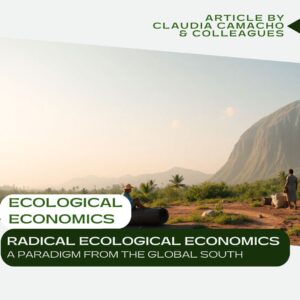
Radical ecological economics: A paradigm from the global south

Posted on March 4, 2026June 24, 2026 by CASAS

Claudia Camacho (CASAS’ member) has co-authored this article with David Barkin, Erika Carcaño & Alejandra Sánchez in Ecological Economics.

Abstract: Radical Ecological Economics is a more appropriate way for collaboration with communities in the Global South. It transcends the conceptual and methodological premises of Ecological Economics, integrating realities that are not commonly considered, but exist and actively resist throughout the world. The text addresses three major areas: 1) the broadening of the understanding of the social, not only as “the human” but as the encounter of complex structures of organization, of biological and cultural reproduction, of identity reaffirmation and even the search for autonomy in the face of historical oppressions whose leadership is entrusted to a Revolutionary Communitarian Subject; 2) the understanding that, within this social complexity, there are realities that are not generally considered, in which the natural endowment and goods for consumption and enjoyment are not allocated by market mechanisms; where production is organized as part of the social fabric; in which surpluses take multiple material and non-material forms, and are distributed for the common good (human and non-human); and in which socioecological metabolic configurations are nourished by historical cosmovisions that respect the biophysical limits of ecosystems; 3) REE has clear ontological, epistemological, methodological, and political foundations, taking into account a diversity of realities. This formulation offers a comprehensive method to understand the multiple worlds and approaches of millenarian societies that now are forging worlds outside the capitalist model by communities committed to alleviating the multi-scale crisis that afflicts them.

Read their full article here: https://doi.org/10.1016/j.ecolecon.2026.108939

Follow us on our social media
  • Facebook
  • Twitter
  • Instagram

Share this:

  • Share on X (Opens in new window) X
  • Share on Facebook (Opens in new window) Facebook
  • Share on LinkedIn (Opens in new window) LinkedIn
  • Print (Opens in new window) Print

Like this:

Like Loading…

CASAS

Avatar photo

The Collective of Agrarian Scholar-Activists from the Global South (CASAS) is a community of Scholar-Activists working in critical agrarian studies.

Leave a ReplyCancel reply

RECENT POSTS

  • Paguyuban Petani Lahan Pantai Opposing the Neoliberal Policy in the Kulon Progo Coastal Area
  • Movimentos agrários e a luta pela transformação agroalimentar na África Austral
  • Looking back to move forward: historical Agroecology and reciprocity in Ecuador and Bolivia
  • Reproducing Operational Landscapes: The Rock Mining for Indonesia’s New Capital City
  • Private Land Ownership, Race and Class Consideration (1964-1985)

CATEGORIES

  • CASAS' members publications
  • Conferences
  • Insights from the ground
  • JPS Food Sovereignty
  • JPS Writeshop
  • Multimedia
  • News
  • Special Issues
  • Who is who in CASAS?

ARCHIVES

  • June 2026
  • May 2026
  • April 2026
  • March 2026
  • February 2026
  • January 2026
  • December 2025
  • November 2025
  • October 2025
  • September 2025
  • August 2025
  • July 2025
  • June 2025
  • May 2025
  • April 2025
  • March 2025
  • February 2025
  • January 2025
  • December 2024
  • November 2024
  • October 2024
  • September 2024
  • August 2024
  • July 2024
  • June 2024
  • May 2024
  • April 2024
  • March 2024
  • February 2024
  • January 2024
  • December 2023
  • November 2023
  • October 2023
  • September 2023
  • August 2023
  • July 2023
  • May 2023
  • April 2023
  • March 2023
  • February 2023
  • January 2023
  • December 2022
  • November 2022
  • October 2022
  • September 2022
  • August 2022
  • May 2022
  • February 2022
  • July 2021
  • April 2021
  • March 2021
  • February 2021
  • January 2021
  • December 2020
  • November 2020
  • October 2020
  • August 2020
  • July 2020
  • June 2020
  • May 2020
  • April 2020

RECENT COMMENTS

  1. Mercedes Ejarque on Call for applicants: Writeshop 2026
  2. shemilkalayath on Call for applicants: Writeshop 2026
  3. Why Palestine is a feminist and an anti-colonial issue  | ROAPE on Palestine: Reaffirming our commitment for a solidarity-based network of agrarian studies global-south scholars
  4. Mercedes Ejarque on Call for applicants: Writeshop 2026
  5. tranquil865a3fc7cd on Call for applicants: Writeshop 2026

TAGS

Africa Agrarian Change agribusiness agriculture Agroecology Argentina Asia authoritarianism Bolivia Brazil Chile China climate change COHD Colombia conflict COVID-19 Critical Agrarian Studies Development Studies Ecuador Extractivism food sovereignty gender Global South India Indonesia JPS land rush Latin-america mexico Middle East Mozambique pandemic pastoralism scholar activism Social Movements social reproduction South Africa South America sustainability Turkey Violence vulnerability writeshop Zimbabwe

CONNECT WITH CASAS

RSSTwitterFacebookLinkedin

SUSCRIBE BY EMAIL

CASAS SOUTH FACEBOOK

Tweets by Casas_South

Meta

  • Log in
  • Entries feed
  • Comments feed
  • WordPress.org
©2026 Collective of Agrarian Scholar-Activists from the South | Built using WordPress and Responsive Blogily theme by Superb
%d