
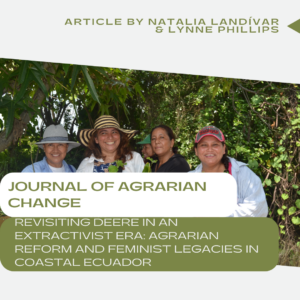
CASAS’ member Natalia Landívar has published this article with Lynne Phillips in the Journal of Agrarian Change.
Abstract: This article examines how campesinas in coastal Ecuador have navigated shifting labour roles, financial precarity and ecological degradation under Plan Tierras, a state-led land redistribution policy embedded in an extractivist model of agriculture. While Plan Tierras formally recognized women as land beneficiaries, we argue that it intensified women’s burdens across blurred boundaries between productive, reproductive and ecological spaces. Building on feminist political ecology and recent debates on the labours of social reproduction, we conceptualize agrarian extractivism as a process that simultaneously depletes women’s bodies, emotions and the ecological foundations of life. Drawing on ethnographic research in Hacienda Las Mercedes, we show how women’s everyday practices reveal the convergence of production, reproductive and ecological labour within circuits of extraction that sustain agrarian capitalism. This framework highlights the contradictions of state-led reforms that rely on women’s unpaid and affective work while undermining the material and ecological conditions that sustain it. Yet, women also resist extractivist pressure through grounded, care-centred practices that sustain livelihoods and reassert campesina identities. By revisiting the foundational work of Carmen Diana Deere, this article offers a critical feminist lens on agrarian reform, calling for a transition from inclusion-based policies to reproductive and ecological justice.
Read the full article here: https://doi.org/10.1111/joac.70058
CASAS

The Collective of Agrarian Scholar-Activists from the Global South (CASAS) is a community of Scholar-Activists working in critical agrarian studies.
Leave a Reply