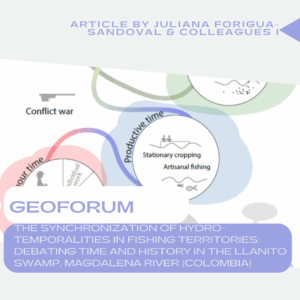
CASAS’ member Juliana Forigua-Sandoval has published this article in Geoforum with colleagues Lieke Anna Melsen, Bibiana Duarte-Abadía & Rutgerd Boelens.
Abstract: This article introduces the concept of hydrotemporalities to analyze the history of the fishing hydrosocial territory of Llanito Swamp in the Middle Magdalena River. Specifically, this research contributes to debates on the temporal dimensions of water ecosystems territorialization and how political disputes become materialized as a result of competing assertions of time. Using methodologies of oral history and ethnographic interviewing, we argue that the history of this fishing hydrosocial territory has been shaped by different hydrotemporal forces, such as biorhythms, productive time, labour time, machinery time and memorial time. In this context, we demonstrate how diverse actors—including landlords, private-sector hydropower companies, and the state as represented by the public oil company—have sought to synchronize the river’s temporalities through diverse mechanisms, to serve their own interests at the expense of grassroots actors. We reflect on how this synchronization of the river represents an acceleration and compression of time, driven by the demands of emerging capital dynamics in the swamps, challenging the historically developed livelihood opportunities and cultural identities of fisher’s communities.
Read their full text here: https://www.sciencedirect.com/science/article/pii/S0016718525001812
CASAS

The Collective of Agrarian Scholar-Activists from the Global South (CASAS) is a community of Scholar-Activists working in critical agrarian studies.
Leave a Reply