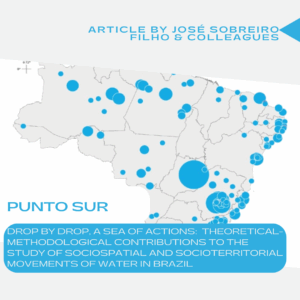
CASAS’ member José Sobreiro Filho has published this article in portuguese with colleagues Nelson Gabriel, Luis Henrique Marques Rosa Buani, Miriam Moura, Ronaldo Barros Sodré, Wuelliton Felipe Peres Lima, Isabelle Avon Carolino Vanderlei & Márcia Renata Carvalho Santos in Punto Sur journal.
Abstract: Territorial disputes over natural resources have marked the history of Latin America. The growing neoliberal agenda and the advancement of financialization of natural assets are expressions of the process of commodification of nature and accumulation through spoliation, to the detriment of traditional peoples and communities. As a result of these and other processes, water spaces have become territorially contested, highlighting an unequal correlation aimed at controlling the resources embedded within these territories. Fishermen, shellfish gatherers, riverside dwellers, indigenous peoples, and many other individuals have started to organize themselves and form socioterritorial movements in different regions of Brazil, now expanding into a transnational struggle while maintaining strong local ties. Given this scenario, our objective is to highlight the innovative methodo-logical contribution of the Land Struggle Database (DATALUTA) and the theoretical framework regarding socioterritorial movements in order to comprehend the contentious politics promoted around water territories in Brazil between 2020-2021.
Read the full article in Portuguese: https://doi.org/10.34096/ps.n12.14543
CASAS

The Collective of Agrarian Scholar-Activists from the Global South (CASAS) is a community of Scholar-Activists working in critical agrarian studies.
Leave a Reply