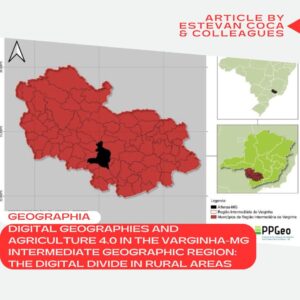
CASAS’ member Estevan Coca has published this article in Portuguese with Adriano Pereira Santos & Rodrigo Giacopini in GEOgraphia.
Abstract: With the advent of the 4th Industrial Revolution, the countryside faces the so-called Agriculture 4.0. A broad set of innovations such as artificial intelligence, the Internet of Things, drones, sensors, and so on have been seen as drivers for changes in the way of farming. In dialogue with the literature on digital geographies, which addresses how digitalization is part of socio-spatial processes of exclusion, negative inclusion, enrichment, and impoverishment, this paper raises the question: hasthis been experienced homogeneously by agribusiness and peasant family farming production models? Based on 32 semi-structured interviews with farmers, digital technology providers, agricultural technicians, and participation in events promoting digital technologies for the countryside, we seek to answer this question by focusing on the Intermediate Geographic Region of Varginha. We address three elements of this process: the types of technologies accessed by farmers, the impact on labor relations, and control over technology. The results indicate that Agriculture 4.0 has been accessed and experienced with much greater intensity by agribusiness, widening the digital divide in agriculture. This has implications for the limits and contradictions of the innovations brought about by the Fourth Industrial Revolution in the Global South
Read their full article here:
CASAS

The Collective of Agrarian Scholar-Activists from the Global South (CASAS) is a community of Scholar-Activists working in critical agrarian studies.
Leave a Reply