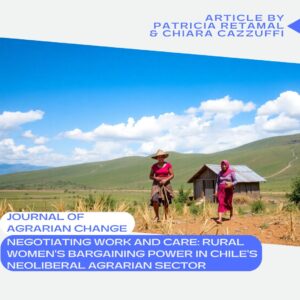
Patricia Retamal (CASAS’ member) and Chiara Cazzuffi have published this article in the Journal of Agrarian Change.
Abstract: Women’s participation in paid work is widely expected to enhance bargaining power within households and promote redistribution of unpaid domestic and care work. Yet, in agrarian contexts shaped by long-standing neoliberal labour regimes, this expectation often remains unmet. This article examines why paid work fails to translate into redistribution of unpaid work within households, drawing on qualitative interviews with women in rural central Chile. Using Agarwal’s cooperative–conflict framework, the analysis assesses bargaining power through observable household outcomes, focusing on the organization of unpaid domestic and care work. The findings show that paid work does not strengthen bargaining power unless it alters the organization of social reproduction within the household. Bargaining capacity operates through embodied and temporal mechanisms: The physical depletion and time rigidity associated with insecure and physically demanding employment arrangements undermine women’s ability to pursue and sustain redistribution, even when they explicitly ask their partners for greater support with domestic and care work. Redistribution emerges as a fragile outcome that depends on specific configurations of social reproduction, including time control, lower caregiving intensity and the social legitimation of women’s paid work and time priorities. By centring unpaid domestic and care work as the primary observable outcome of intra-household bargaining, the study offers a relational and temporally grounded reconceptualization of empowerment in agrarian labour regimes.
Read their full article here: https://doi.org/10.1111/joac.70078
CASAS

The Collective of Agrarian Scholar-Activists from the Global South (CASAS) is a community of Scholar-Activists working in critical agrarian studies.
Leave a Reply