
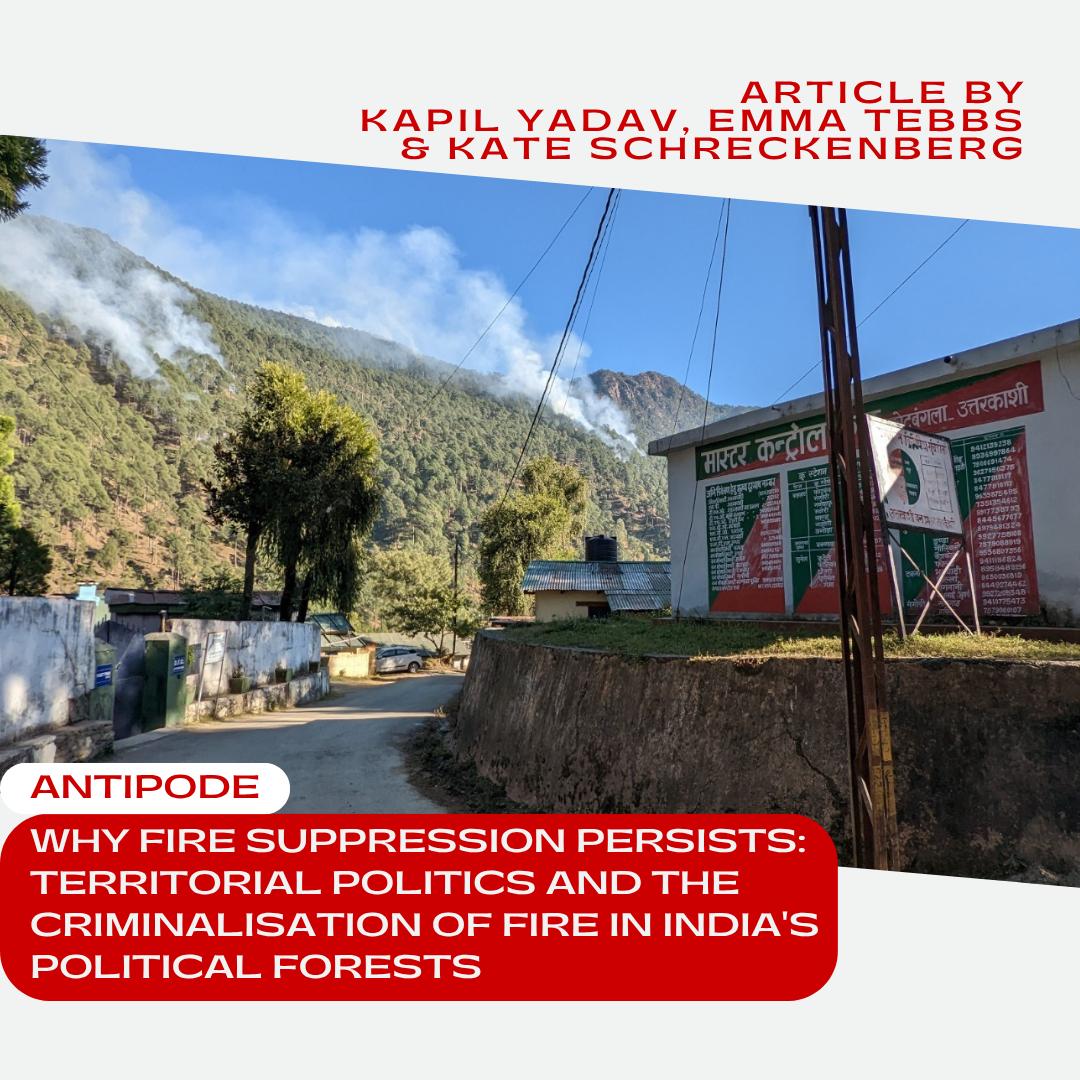
CASAS’ member Kapil Yadav has published this article with Emma Tebbs & Kate Schreckenberg in Antipode.
Abstract: Why does fire suppression remain central to forest governance globally, despite the increasing recognition of fire’s ecological and livelihood significance? This study examines the persistence of fire suppression in India, arguing that it continues not for ecological reasons but as a political technology of state territorial control. Drawing on archival research and interviews, we trace how colonial era legal and institutional frameworks criminalising community fire use have been carried across successive policy shifts, from timber extraction to biodiversity conservation to carbon sequestration, centralising authority over forest landscapes and reordering ecologies to serve external interests over local populations. Political forests, however, are not only state projects. Forest-dwelling communities sustain relational lifeworlds through fire practices that exceed the logics of state and capital. Recognising fire suppression as a political tool demands reckoning with the colonial legal frameworks that sustain it and opens the possibility for more just and ecologically grounded fire futures.
Read their full text here: https://doi.org/10.1111/anti.70192
CASAS

The Collective of Agrarian Scholar-Activists from the Global South (CASAS) is a community of Scholar-Activists working in critical agrarian studies.
Leave a Reply