
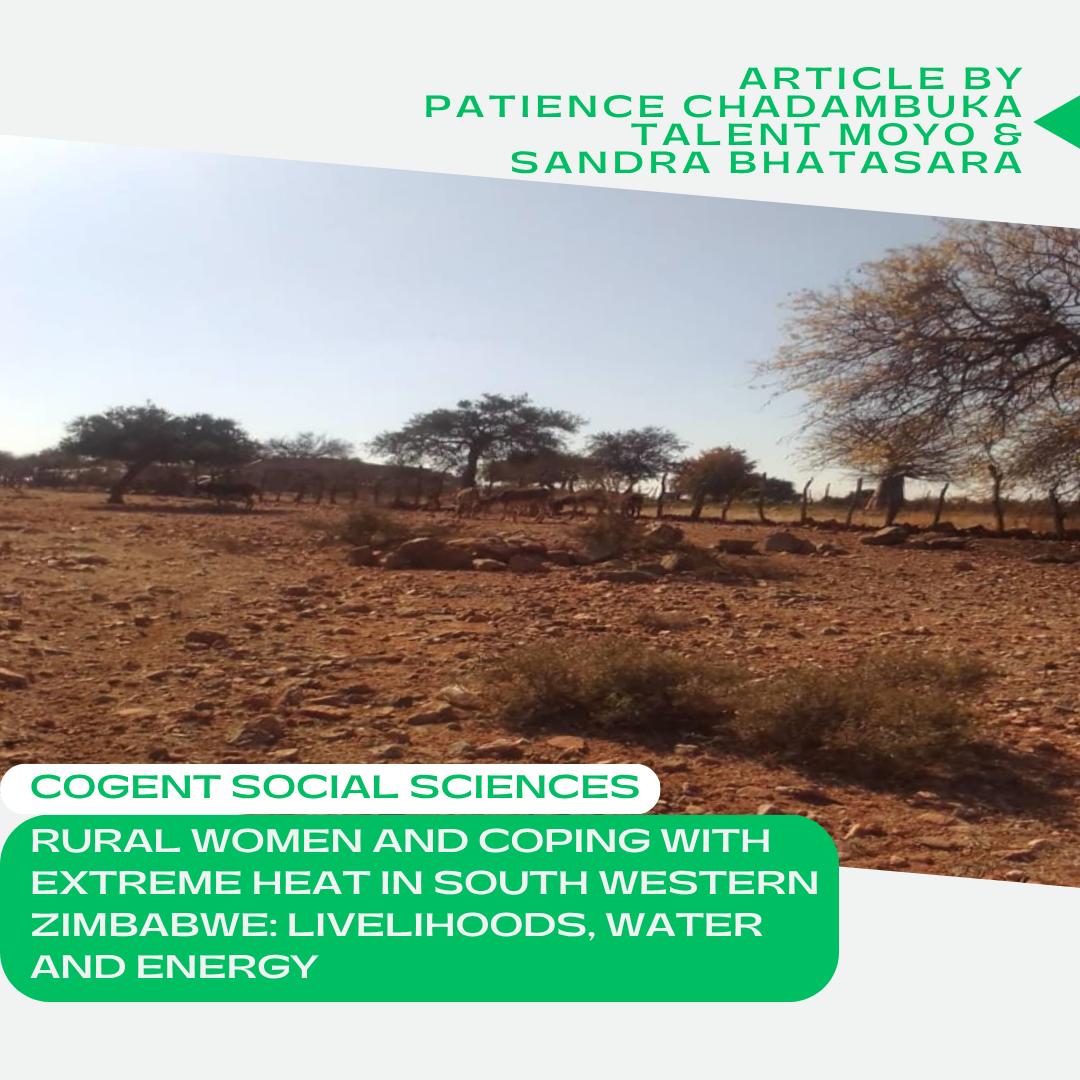
Patience Chadambuka (CASAS’ member) has published this article with colleagues Talent Moyo & Sandra Bhatasara in Cogent Social Sciences.
Abstract: This article focuses on rural women’s agency and innovation in the context of the global acceleration of climate change-induced extreme heat. Specifically, it considers the intersecting challenges encountered in relation to livelihoods, water, and energy, as well as the coping strategies adopted by diverse rural women. While currently there is an upsurge of studies focusing on extreme heat, they are mostly generic in terms of gender and largely framed within the broader context of climate change not specifically on extreme heat. We use the intersectional ecofeminist perspective to analyze how different women are disproportionately affected by extreme heat. We also examine how ‘better-off’ rural women, in their relative capacities, capitalize on the heat crisis in the absence of institutional assistance. We argue that the most vulnerable rural women bear the brunt of climate change-induced crises, yet their subjective experiences remain under-represented in climate change discourse and policies. This qualitative research is based on data drawn from key informant interviews, in-depth interviews and focus group discussions conducted in Beitbridge district, southern Zimbabwe. The paper recommends policy makers and other stakeholders to complement extreme heat responces and innovations by vulnerable populations while noting the spatial and gendered dimensions of the climate crisis.
Read their full text here: https://doi.org/10.1080/23311886.2026.2711460
Mercedes Ejarque

Mercedes Ejarque is a researcher at the National Institute of Agricultural Technology (INTA). She is also Professor of Rural Sociology in a Master Program at the University of Buenos Aires (UBA). She holds a Master’s Degree in Social Research and a PhD in Social Sciences from the University of Buenos Aires. Her research focuses on society – nature relations around agrarian activities, social constructivism of environmental problems and political ecology in Patagonia. She has also published about methodological issues in agrarian research, rural labour markets and rural-urban tendencies.
Leave a Reply