Skip to content
Collective of Agrarian Scholar-Activists from the South

Collective of Agrarian Scholar-Activists from the South

agrarian studies, global south, scholar-activists

Menu
  • Home
  • About
  • Who is who in CASAS?
  • Resources
    • CASAS’ members publications
    • ICAS Books Series
  • Writeshops
  • Contacts
  • Network
Menu

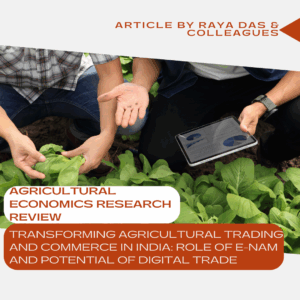
Transforming agricultural trading and commerce in India: Role of e-NAM and potential of digital trade

Posted on May 9, 2025May 3, 2025 by CASAS

Raya Das, CASAS’ member, has published an article in Agricultural Economics Research Review with Bidisha Chanda, Gauri Krishna, and Ashok Gulati

Abstract: This paper explores the transformative role of digital platforms, such as e-NAM (electronic National Agriculture Market) and ONDC (Open Network for Digital Commerce), in reforming agricultural
marketing in India. By increasing market access, transparency, and efficiency, these platforms reduce middlemen dependency and improve price realization of farmers. In this context, the study evaluates eNAM’s influence on price realization and spatial price integration for key agricultural commodities, including rice, wheat, tomato, onion, potato, and turmeric, from January 2011 to April 2024. The study has found that spatial price integration of some of these commodities has improved in the post-e-NAM period compared to the pre-e-NAM period (January 2011 to December 2015). Further, the farmers using the e-NAM platform have experienced significantly higher price realizations than those trading in non-eNAM APMC mandis for the same commodities. However, despite these positive outcomes, e-NAM’s contribution to the total APMC trade volume remains minimal, accounting for only 6 per cent as of Financial Year 2023-2024, with just 20 per cent of APMCs onboarded to the platform. The study also identifies significant challenges of e-NAM platform, including low inter-state trade and the dominance of intra-mandi transactions. The paper also highlights the ONDC’s potential to foster direct connections between farmers and buyers while democratizing the digital landscape, offering significantly lower commission rates compared to traditional platforms. However, addressal of digital divide and development of rural infrastructure are crucial for increasing farmers’ participation and advancing digital integration in the agricultural marketing sector of India.

Read their article here: 10.5958/0974-0279.2024.00012.X

Follow us on our social media
  • Facebook
  • Twitter
  • Instagram

Share this:

  • Share on X (Opens in new window) X
  • Share on Facebook (Opens in new window) Facebook
  • Share on LinkedIn (Opens in new window) LinkedIn
  • Print (Opens in new window) Print

Like this:

Like Loading…

CASAS

Avatar photo

The Collective of Agrarian Scholar-Activists from the Global South (CASAS) is a community of Scholar-Activists working in critical agrarian studies.

Leave a ReplyCancel reply

RECENT POSTS

  • When Reformers Become Spoilers: Discretionary Implementation of Extraordinary Restitution Reform under Extractivism in Colombia
  • Mapping Fire Management: A Spatial Social Network Approach
  • Review of “Circular ecologies: environmentalism and waste politics in Urban China by Amy Zhang”
  • Digital geographies and agriculture 4.0 in the Varginha-mg intermediate geographic region: the digital divide in rural areas
  • Indigenous Pathways to Social Justice, Reconciliation, Healing and Well-being with all Our Relations

CATEGORIES

  • Blogs
  • CASAS Members
  • CASAS' members publications
  • Multimedia
  • News
  • Resources
  • Who is who in CASAS?
  • Writeshops

ARCHIVES

  • May 2026
  • April 2026
  • March 2026
  • February 2026
  • January 2026
  • December 2025
  • November 2025
  • October 2025
  • September 2025
  • August 2025
  • July 2025
  • June 2025
  • May 2025
  • April 2025
  • March 2025
  • February 2025
  • January 2025
  • December 2024
  • November 2024
  • October 2024
  • September 2024
  • August 2024
  • July 2024
  • June 2024
  • May 2024
  • April 2024
  • March 2024
  • February 2024
  • January 2024
  • December 2023
  • November 2023
  • October 2023
  • September 2023
  • August 2023
  • July 2023
  • May 2023
  • April 2023
  • March 2023
  • February 2023
  • January 2023
  • December 2022
  • November 2022
  • October 2022
  • September 2022
  • August 2022
  • May 2022
  • February 2022
  • July 2021
  • April 2021
  • March 2021
  • February 2021
  • January 2021
  • December 2020
  • November 2020
  • October 2020
  • August 2020
  • July 2020
  • June 2020
  • May 2020
  • April 2020

RECENT COMMENTS

  1. Mercedes Ejarque on Call for applicants: Writeshop 2026
  2. shemilkalayath on Call for applicants: Writeshop 2026
  3. Why Palestine is a feminist and an anti-colonial issue  | ROAPE on Palestine: Reaffirming our commitment for a solidarity-based network of agrarian studies global-south scholars
  4. Mercedes Ejarque on Call for applicants: Writeshop 2026
  5. tranquil865a3fc7cd on Call for applicants: Writeshop 2026

TAGS

Africa Agrarian Change agribusiness agriculture Agroecology Argentina Asia authoritarianism Brazil Chile China climate change COHD Colombia conflict COVID-19 Critical Agrarian Studies Development Studies Extractivism food sovereignty gender Global South India Indonesia JPS land grabbing Land reform land rush Latin-america mexico Middle East pandemic pastoralism rural development scholar-activism Social Movements social reproduction South Africa South America sustainability Turkey Violence vulnerability writeshop Zimbabwe

CONNECT WITH CASAS

RSSTwitterFacebookLinkedin

SUSCRIBE BY EMAIL

CASAS SOUTH FACEBOOK

Tweets by Casas_South

Meta

  • Log in
  • Entries feed
  • Comments feed
  • WordPress.org
©2026 Collective of Agrarian Scholar-Activists from the South | Built using WordPress and Responsive Blogily theme by Superb
%d