
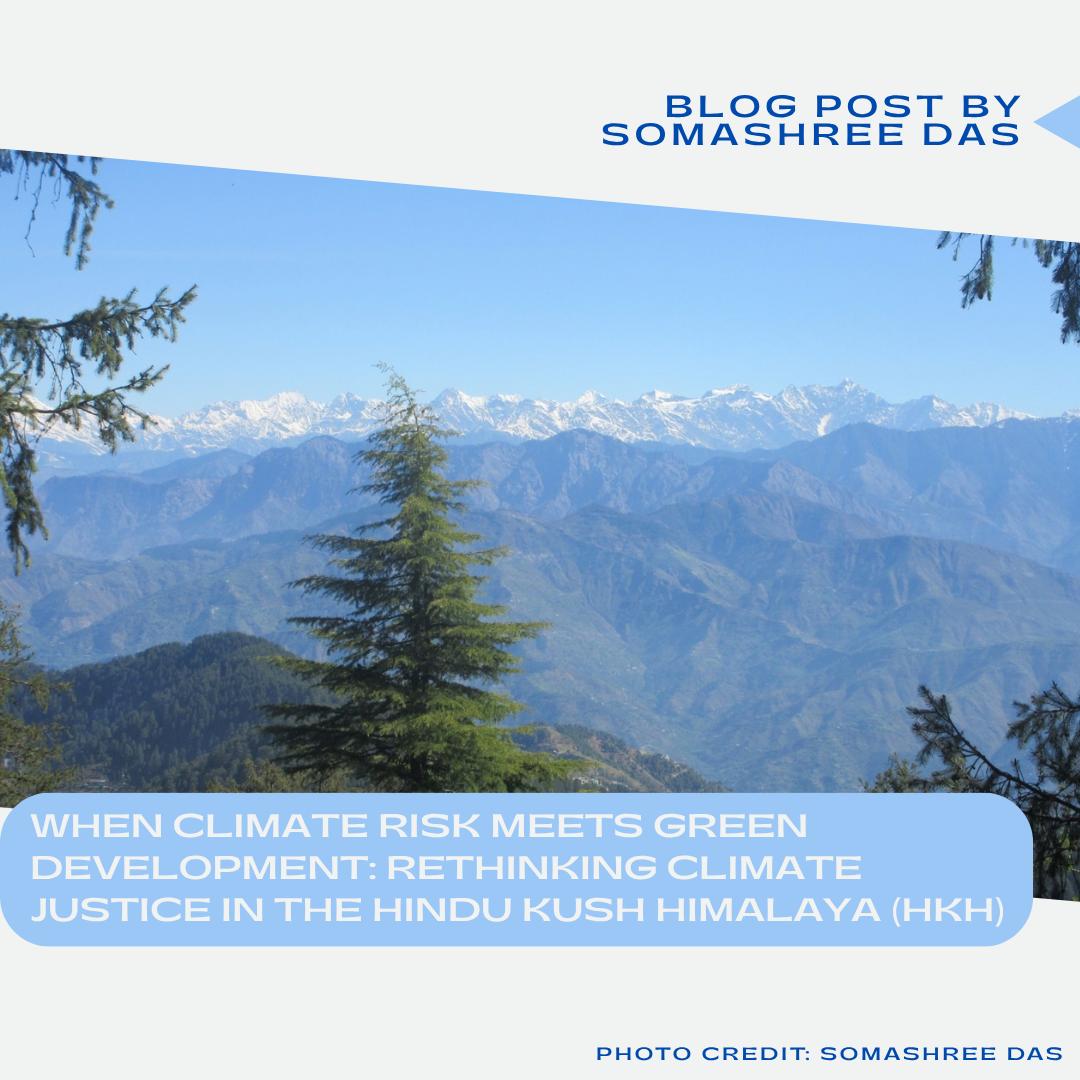
CASAS’ member Somashree Das wrote this piece about an intriguing question: to what extent can green development become true climate action when it is increasingly exposed to the climate crisis?
The Hindu Kush Himalaya (HKH) is increasingly on the front lines of the climate crisis. In recent years, the region has witnessed a succession of major disasters, including Kedarnath floods in Uttarakhand in 2013, Melamchi flood in Nepal in 2021, South Lhonak glacial lake outburst flood (GLOF) in Sikkim in 2023, Thame GLOF in Nepal in 2024, Dharali disaster in Uttarakhand in 2025 and most recently, the catastrophic August 2026 flash flood in Nepal. These events exposed the region’s growing exposure to climate-related risks, including GLOFs, landslides, flash floods and related cascading hazards, posing growing threats to downstream communities and infrastructure. The hazard environment of the HKH mountain landscape also interacts with rapid hydropower and infrastructure expansion in the name of ‘green development’, posing new threats to mountain communities and infrastructure.
This interaction of growing climate threat and development practice raises a pertinent question: to what extent can green development become true climate action when it is increasingly exposed to the climate crisis? This question is particularly significant in light of the international commitment to disaster reduction under the Sendai Framework, which commits countries to substantially reduce disaster risk by 2030. With only four years remaining to achieve this goal, recurring and intensifying climate disasters in the HKH highlight the persistent gap between global commitments and the scale of action needed to tackle the climate crisis, leaving developing and climate-vulnerable countries increasingly exposed to escalating climate risk.
Vulnerability in HKH: What Nepal Disaster Reveals
The HKH, spanning eight countries, i.e. Afghanistan, Bangladesh, Bhutan, China, India, Myanmar, Nepal and Pakistan, is often described as the world’s ‘Third Pole’ due to its extensive snow and ice reserves. However, the region is undergoing a rapid cryospheric transformation under climate change. Recent assessment by the International Centre for Integrated Mountain Development (ICIMOD) shows that the rate of glacier ice-loss in the HKH has doubled since 2000, with glaciers losing approximately 12% of their total area and 9% of their estimated ice reserves between 1990 and 2000. Increasing glacier melt and the resulting expansion of glacial lakes increase the potential for extreme events such as GLOFs, flash floods, landslides, debris flows, etc. These events also intersect with the rapidly transforming mountain economy. The expansion of hydropower projects, roads, and tourism activities, which are often presented as pathways to energy security, decarbonization, and economic development, is increasingly creating concentrated sites of risk and exposure.
The recent 27 August 2026 Nepal disaster illustrates these risks. Satellite observations indicate that a large glacier collapse near the Nepal-China border triggered a destructive cascade of ice, rock and water flowing downstream, causing the Bhote Koshi and Trishuli rivers to overflow while destroying settlements and critical infrastructure. Thirteen operational and under-construction hydropower projects reportedly suffered direct damage, while hundreds of workers were initially unaccounted for, and subsequent reporting documented extensive loss of life and thousands of people missing. Nepal’s disaster authority estimated losses of at least US$2.56 billion, although the actual costs are socially differentiated. A political economy perspective shows that disaster is not simply a product of an extreme event; rather, it emerges through the interaction of hazard, exposure, infrastructure, institutional capacity and socially differentiated vulnerability. Financial losses to investors, reconstruction expenditure for the state and the loss of homes, livelihoods, or life are not equivalent forms of loss. These impacts intersect with multiple and overlapping inequalities of gender, class, caste, ethnicity, age and occupation, shaping who is exposed, who can access protection, and who bears the costs of disasters. The central question, therefore, is not simply whether climate change is intensifying the hazards situation, but how climate change, under the current development model, shapes who is exposed to risk, who accesses protection, and who bears the cost. These questions place climate justice at the centre of the HKH’s development trajectory.
The Geography of Responsibility and Climate Justice
The questions of vulnerability of HKH directly connect to the politics of global climate governance. In response to growing concerns over climate change, the Conference of the Parties (COP) under the United Nations Framework Convention on Climate Change (UNFCCC) has, over successive meetings, provided a platform for global cooperation on mitigation and adaptation. The principle of common but differentiated responsibilities and respective capabilities (CBDR-RC) recognises countries’ unequal historical contribution to the climate crisis and unequal capacities to respond. Developing countries, despite their relatively lower contribution to the climate crisis, often face greater vulnerability because of limited fiscal capacity to finance mitigation, adaptation, and disaster recovery and reconstruction. Recognising these financial challenges, successive COPs have established climate finance mechanisms to support developing countries. For example, at COP15 (2009) in Copenhagen, developed economies committed to mobilise US$100 billion annually by 2020 for developing nations, while the Green Climate Fund (GCF) was established as a key financing mechanism. The Paris Agreement (COP21) in 2015 further strengthened developed nations’ financial commitments for developing countries’ mitigation and adaptation efforts. More recently, COP29 (2024) established the New Collective Quantified Goal (NCQG), further scaled up the financial target for developed countries to US$300 billion annually by 2035, while broadening the investment goal from public and private sources to US$1.3 trillion annually. However, this expanding climate finance architecture has not necessarily translated into meaningful material support for those most vulnerable to climate risks.
Three primary impasses in mobilising climate finance to developing countries are commonly noted. First, a persistent gap remains between commitment and delivery. While developed economies committed to mobilise US$100 billion annually by 2020, they could only achieve the target for the first time in 2022, reaching US$115.9 billion. This delay highlights the difficulty in translating political commitments into predictable financial flows. Second, a substantial gap remains between climate finance delivered and finance required. Although global climate finance has expanded significantly in recent years, reaching approximately USD 2.1 trillion in 2025, it still falls short relative to developing countries’ climate-finance needs. The UNFCCC Standing Committee on Finance identified that financial needs in Nationally Determined Contributions (NDCs) of 98 developing countries amount to approximately US$5.1-6.8 trillion through 2030 (UNFCCC 2024), highlighting the substantial financial gap. Third, concerns remain over the unequal geographical distribution and the quality of climate finance. According to the Global Landscape of Climate Finance 2026 report (CPI, 2026), advanced economies and China roughly constitute around 80% of global climate finance flows, while it remains marginal for developing economies. Moreover, a substantial share of public finance is delivered through loans. This places the advanced countries with stronger institutions, financial systems, and project-preparation capacity in a better position to access international climate finance than poorer, more vulnerable countries already facing fiscal and debt constraints. This raises concerns about climate justice for developing nations, for whom the adequacy and accessibility of climate finance remain pressing questions.
The HKH’s Climate Finance Paradox
The climate finance paradox is clearly evident for HKH. The region, which is highly exposed to climate risks, requires enormous investment in mitigation and adaptation, especially for vulnerable countries like Bangladesh, Bhutan, India, Myanmar, Nepal, and Pakistan, which have limited fiscal capacity and are least equipped to manage these risks. According to the International Centre for Integrated Mountain Development’s (ICIMOD) Climate Finance Synthesis Report, the eight HKH countries collectively require approximately US$768.68 billion annually as climate finance, with China and India accounting for around 92.4% of the total projected need. The report highlights that actual disbursements remain far below actual needs, creating barriers for vulnerable countries to protect communities and livelihoods against growing climate threats. The report reveals significant gaps between committed funds and financial delivery from multinational sources across HKH countries, ranging from 19% for Nepal to 59% for Bhutan, with Bangladesh being an exception, which has experienced higher disbursements than commitments.
This gap exposes a significant asymmetry between finance required and finance delivered. It should be highlighted that any investment is easier to mobilise for infrastructure that is capable of generating financial returns. The hydro-power projects in the HKH thus attract finance, as electricity generation produces revenue. However, the adaptation investments for a climate-resilient infrastructure, such as early-warning systems, hazard mapping and assessment, risk monitoring, adaptive infrastructure, resilient design, emergency preparedness, ecological restoration, etc., which generate enormous social benefits, may not produce measurable financial returns. Thus, the finance disproportionately supports green development in the form of hydro-power projects in the region, while financing for resilient infrastructure remains substantially inadequate.
The August 26 Nepal Flash Flood exposes this asymmetry. The event reportedly destroyed thirteen operational and under-construction hydropower projects, disrupting at least 10% of Nepal’s installed electricity generation capacity. This massive destruction reveals a significant gap in investment in adaptation-related mechanisms and in designing resilient infrastructure. Hydro-power projects in Nepal have attracted international finance for mitigation-oriented mechanisms in support of expanding green infrastructure; however, these low-carbon investments are not sufficiently directed toward developing climate-resilient infrastructure. The HKH region, which has increasingly seen large-scale hydropower expansion to meet rising electricity demand and promote local economic development, must integrate climate adaptation to remain resilient, not only to pursue sustainable energy solutions but also to strengthen community resilience and reduce environmental impacts.
Rethinking Climate Finance as Climate Justice: A Way Forward
The lesson from the HKH thus broadens the question of the adequacy of climate finance to the question of what kind of development model it enables. If the finance adequately supports a ‘green’ transition, while leaving climate-risk assessment underfunded, it unintentionally reproduces new lines of vulnerability for the infrastructure as well as for the entire communities and ecosystem. Climate finance needs to integrate both mitigation and adaptation actions to make ‘green’ infrastructure climate-resilient, leading to a socially and ecologically just transition. Thus, climate finance must be directed to true climate action by integrating climate-resilient models in infrastructure. While international finance must be more adequate and accessible, enabling regulatory frameworks and stronger institutional mechanisms for resource mobilisation at the national level are equally important. Moreover, given the transboundary nature of the HKH, regional cooperation on disaster preparedness and infrastructure governance is equally necessary. Under the current climate crisis, the challenge here is not to choose between climate action and development; rather, it needs to be reconsidered what kind of development model is pursued, who finances it and who bears its risks. Climate justice in the HKH ultimately needs fairer relations between finance, development and the communities who live with its consequences.
References
ICIMOD. (2026). HKH Glacier Outlook 2026: Understanding Change Through 50 Years of Field Observation. International Centre for Integrated Mountain Development, Kathmandu. https://lib.icimod.org/records/fk7f9-2ha88
United Nations Framework Convention on Climate Change (UNFCCC). (2024). Second report on the determination of the needs of developing country Parties related to implementing the Convention and the Paris Agreement. Bonn: UNFCCC. UNFCCC document 641042
Climate Policy Initiative (CPI). (2026). Global Landscape of Climate Finance 2026. Climate Policy Initiative, June 2026. https://glcf.climatepolicyinitiative.org/
Ali, G., Maurya, A., Venkatramani, S., Lindhard, C., & Thapa, C. (2025). Climate Finance Synthesis Report: Assessing the needs, flows and gaps in climate financing in the HKH countries. International Centre for Integrated Mountain Development (ICIMOD). https://doi.org/10.53055/ICIMOD.1106
CASAS

The Collective of Agrarian Scholar-Activists from the Global South (CASAS) is a community of Scholar-Activists working in critical agrarian studies.
Leave a Reply