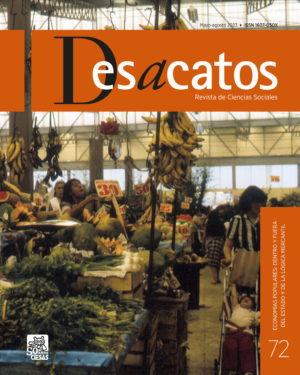
Check out this new article by Mercedes Ejarque (CASAS member), María Guadalupe Lamisón and María Virginia Nessi.
To face increasingly exclusive development models, collective and self-managing forms of production, work and access to food have appeared. In this article, we seek to understand how identity and organizational processes contribute to the persistence of these experiences and the changes caused by the COVID-19 pandemic. We base ourselves on a case study of fairs and markets in the Andean Region, in Argentine Patagonia, where, through interviews from a perspective that articulates the popular and solidarity economy and critical agrarian social studies, we identify heterogeneous groups that combine individual motivations and collective objectives with dynamic organizational forms that allow them to respond to emerging challenges and propose new social ties.
You can access the full article, written in Spanish, by the following link: https://desacatos.ciesas.edu.mx/index.php/Desacatos/article/view/2671/1691
Mercedes Ejarque

Mercedes Ejarque is a researcher at the National Institute of Agricultural Technology (INTA). She is also Professor of Rural Sociology in a Master Program at the University of Buenos Aires (UBA). She holds a Master’s Degree in Social Research and a PhD in Social Sciences from the University of Buenos Aires. Her research focuses on society – nature relations around agrarian activities, social constructivism of environmental problems and political ecology in Patagonia. She has also published about methodological issues in agrarian research, rural labour markets and rural-urban tendencies.
Leave a Reply