
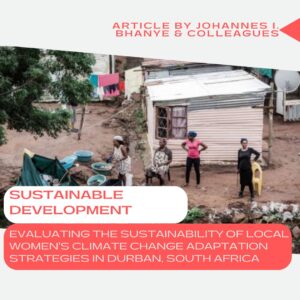
Johannes I. Bhanye, CASAS’ member, has just published an article with Fidelis Udo, Balkissa Daouda Diallo & Maheshvari Naidu in Sustainable Development.
Abstract: This paper employs a feminist political ecology and an intersectionality framework to examine the multiple dimensions of local women’s vulnerability and adaptation to climate change impacts in selected locations in Durban, KwaZulu-Natal Province, South Africa. We focus particularly on assessing the sustainability of the gendered adaptive strategies employed by these women. Utilising a qualitative methodology, the study is based on semi-structured interviews and focus group discussions with local Black women, highlighting the local context of the women’s adaptation to flood impacts. The findings revealed that adaptation strategies are informed by women’s situated knowledge, cultural practices, and agency, illustrating the complex, context-specific nature of responses to climate challenges. We argue that a bottom up approach, which prioritises the effectiveness and sustainability of women’s adaptation strategies, is crucial for fostering longer-term, more equitable, and sustainable solutions to climate impacts. By advocating this approach, the paper contributes to a deeper understanding of gendered adaptation practices that align with global efforts to achieve the Sustainable Development Goals (SDGs) related to gender equality (SDG 5), reducing inequalities (SDG 10), promoting climate action (SDG 13), and sustainable cities and communities (SDG 11).
Read the full article here: https://onlinelibrary.wiley.com/doi/pdf/10.1002/sd.3284
CASAS

The Collective of Agrarian Scholar-Activists from the Global South (CASAS) is a community of Scholar-Activists working in critical agrarian studies.
Leave a Reply