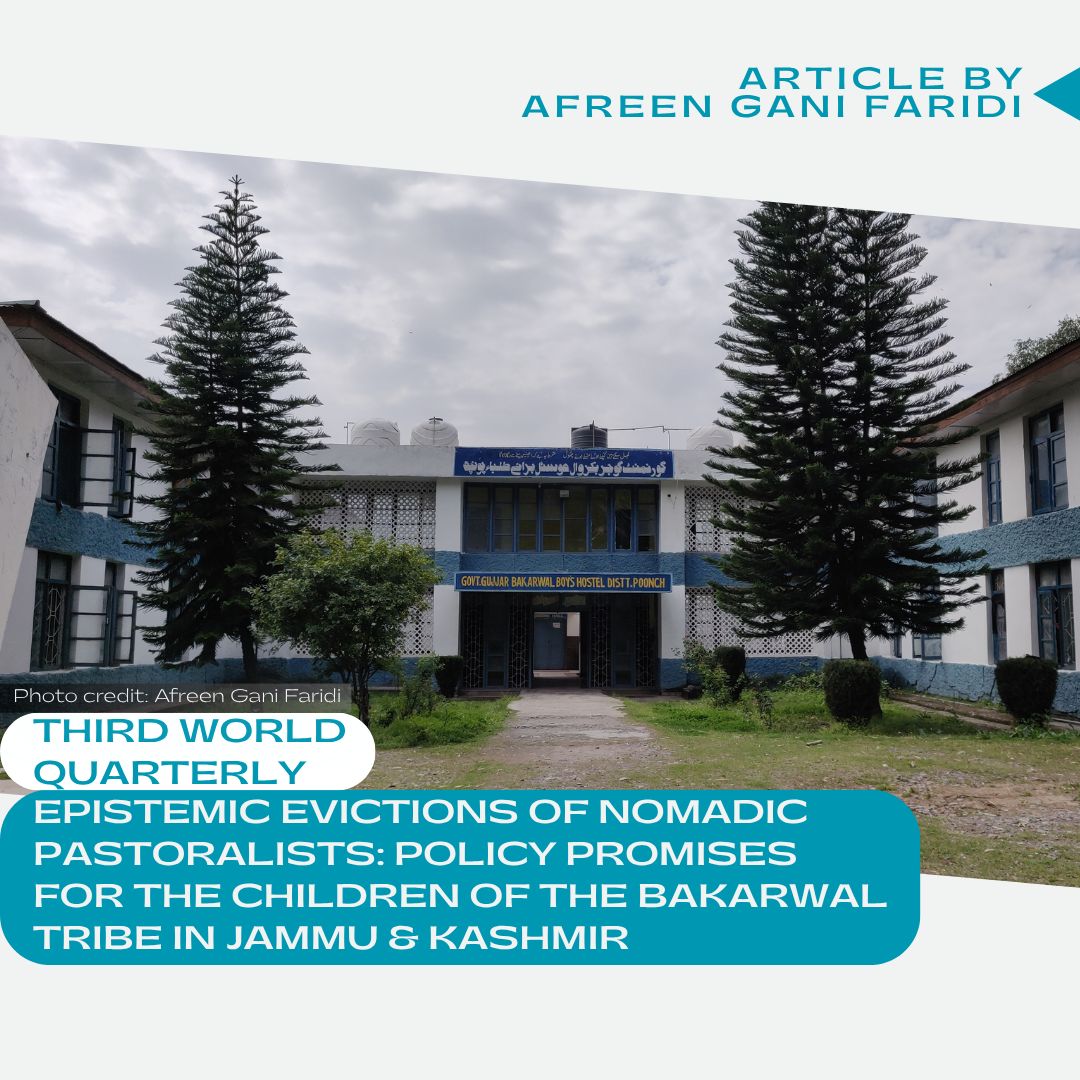
New publication alert! CASAS’ member Afreen Gani Faridi has just published this article in Third World Quarterly. This paper explores the issue of hegemonic bias in education policies which invisibilises the lived environment of pastoralists
Abstract:
The erstwhile state of Jammu and Kashmir is home to one of the largest pastoral transhumance communities in the Himalayas. There is a need to situate state education policy for tribes against the specific mode of production involving nomadic pastoralism and ecological labour. This phenomenon of Transhumance existence acts as an anchor against which the lived experience of the Bakarwal tribe can be located, and any impact of the former bears upon the latter. The existing circumstances of these pastoralist communities can be spatially located against the varied effects imposed upon their ability to practice transhumance. It is in this context that the article analyses the state education policy on securing the futures of the children of the Bakarwal community. The paper highlights the issue of hegemonic bias in state policy on education, which invisibilises the lived environment where the tribe is situated. The paper lays out the effect of formal education on embedded ecologies and epistemes within the community.
Read their full article here: https://doi.org/10.1080/01436597.2026.2678962
CASAS

The Collective of Agrarian Scholar-Activists from the Global South (CASAS) is a community of Scholar-Activists working in critical agrarian studies.
Leave a Reply