
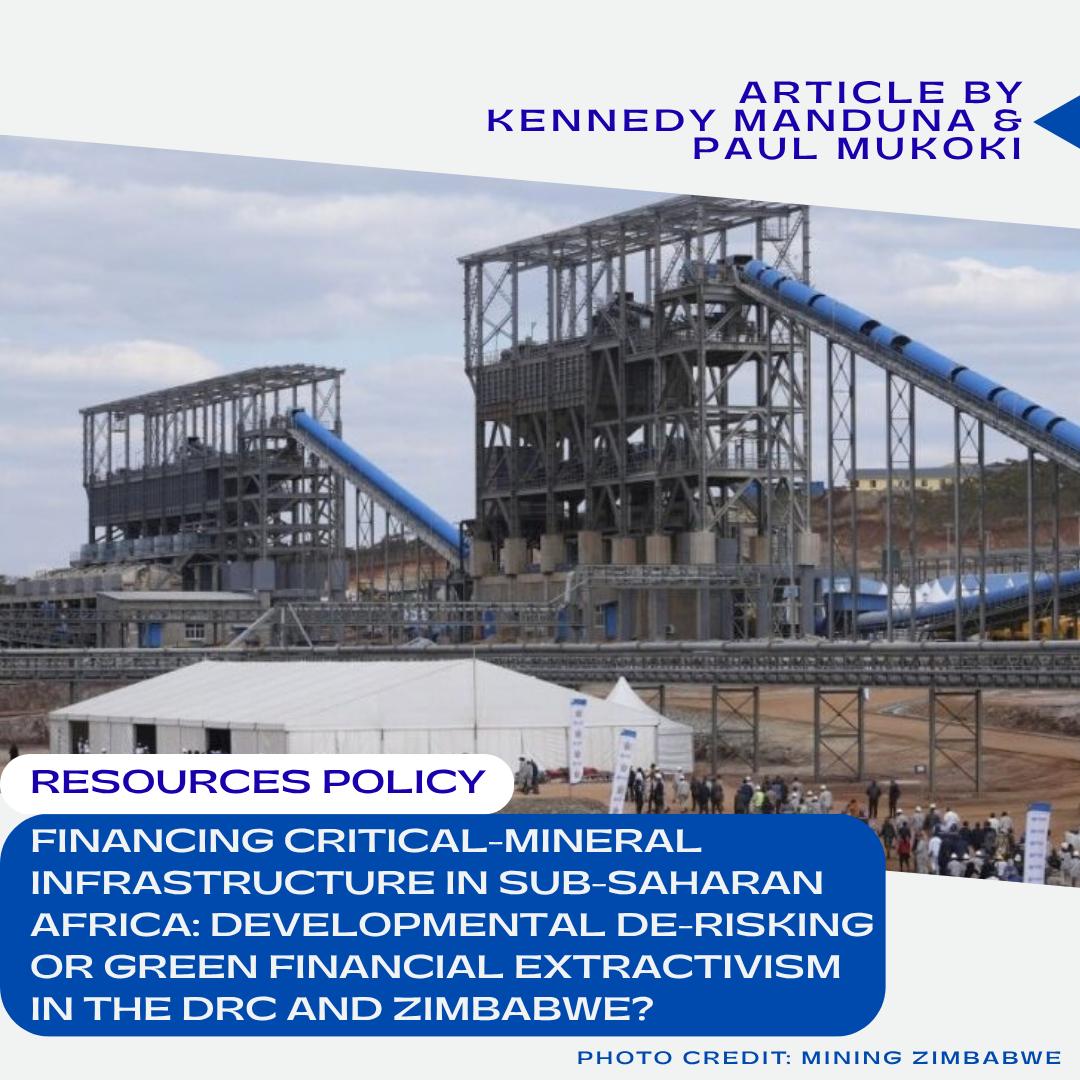
Kennedy Manduna (CASAS’ member) and Paul Mukoki have published this paper in Resources Policy.
Abstract: The global shift towards low-carbon energy systems has heightened demand for copper, cobalt, and lithium, driving investment in African mineral projects. However, developmental outcomes are shaped not only by extraction and processing but also by the financial structures underpinning these projects. This article distinguishes between developmental de-risking, in which public support is linked to shared infrastructure, domestic capability building, public value capture, and accountable participation; and green financial extractivism, in which capital supporting transition-mineral supply chains is protected while fiscal, environmental, or social risks are transferred to host states and communities. Through a structured documentary comparison of Sicomines–Busanga and Kamoa–Kakula in the Democratic Republic of Congo, and Arcadia Lithium and Bikita Minerals in Zimbabwe, the analysis evaluates financing instruments, risk allocation, infrastructure, ownership, value capture, and ESG outcomes. These cases predominantly utilise resource-backed lending, shareholder and commercial debt, offtake advances, corporate equity, and fiscal or regulatory support, rather than climate-labelled finance. Sicomines – Busanga is predominantly green financial-extractivist; Kamoa–Kakula is a hybrid case leaning towards developmental de-risking; Arcadia combines state-facilitated corporate de-risking with externally controlled intermediate beneficiation; and Bikita remains predominantly green-extractivist despite partial developmental upgrading. The findings indicate that critical-mineral finance should be assessed based on risk allocation, infrastructure control, and value capture, rather than solely on green narratives.
Read their paper here: https://doi.org/10.1016/j.resourpol.2026.106035
CASAS

The Collective of Agrarian Scholar-Activists from the Global South (CASAS) is a community of Scholar-Activists working in critical agrarian studies.
Leave a Reply