
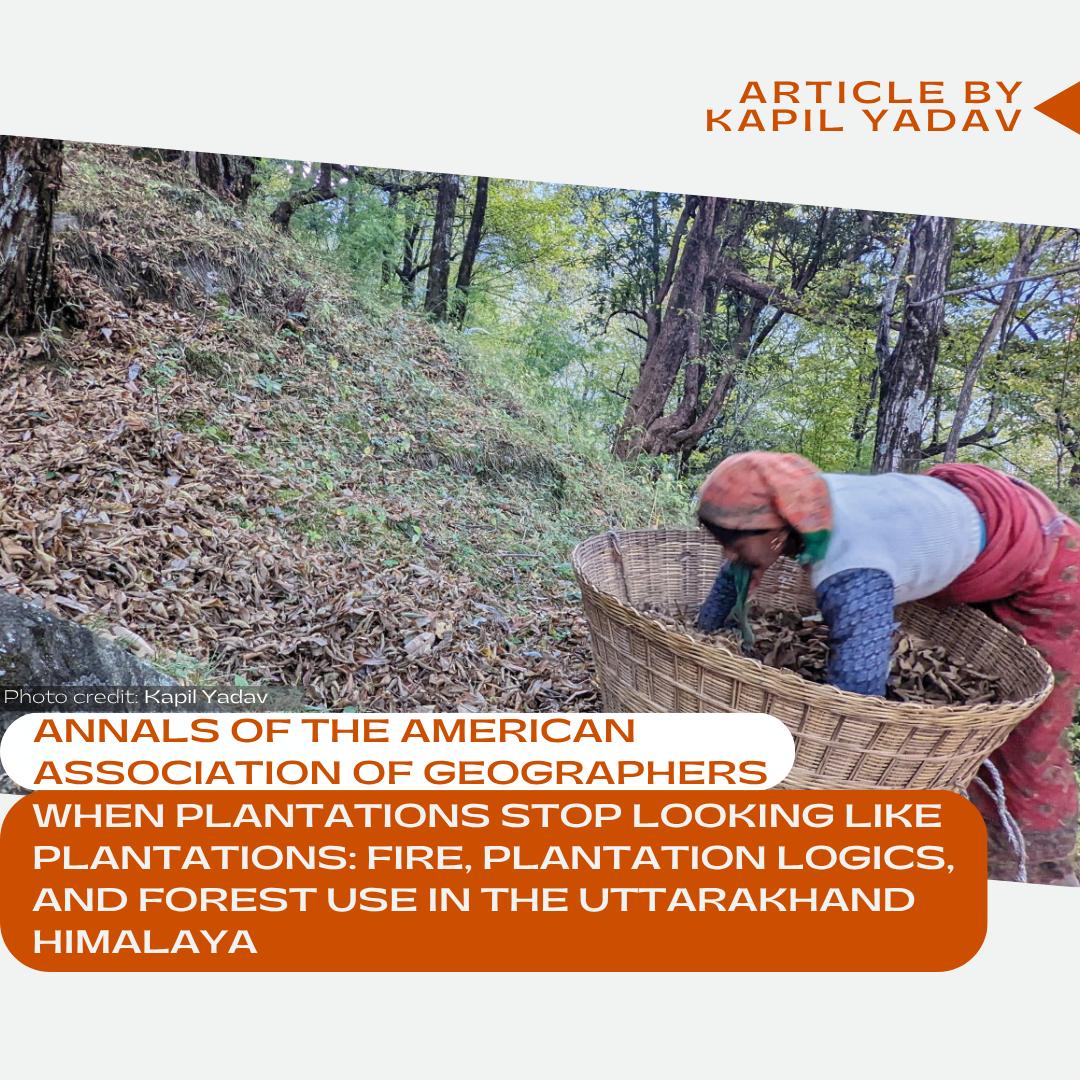
Kapil Yadav (CASAS’ member) has published this article in the Annals of the American Association of Geographers.
Abstract: This study examines forest fires in the Indian Himalayan state of Uttarakhand by shifting attention from ignitions to the historical production of flammable landscapes. It situates contemporary fire regimes within longer histories of landscape transformation and everyday forest use. Drawing on archival research and ethnographic field work, this study employs the plantation–plot binary to examine how state-led plantation forestry and community practices have materially shaped forest vegetation, fuel loads, and fire regimes. Plantation forestry expanded pine dominance and institutionalized fire suppression, producing landscapes with fuel continuity and high flammability that persist long after timber extraction ended. At the same time, everyday practices of rural communities in collecting grass, leaf litter, and fuel wood, conceptualized as plot making, have reduced understory biomass and kept fire intensity low. Plantation and plot are more than competing perspectives; they are two distinct ways of materially making forests that overlap and intersect in the study region. Their interaction helps explain why fires in the region are widespread yet typically remain low-intensity surface fires. By highlighting the role of plantation logics in shaping fire regimes, the article brings plantation studies into dialogue with political ecology and critical human geography of fire. It concludes by arguing that sustainable fire futures depend not only on climate change mitigation but also on how land is used and governed, including the recognition of community forest dependence as a key strategy for reducing fire risk.
Read his article here: https://doi.org/10.1080/24694452.2026.2688348
CASAS

The Collective of Agrarian Scholar-Activists from the Global South (CASAS) is a community of Scholar-Activists working in critical agrarian studies.
Leave a Reply