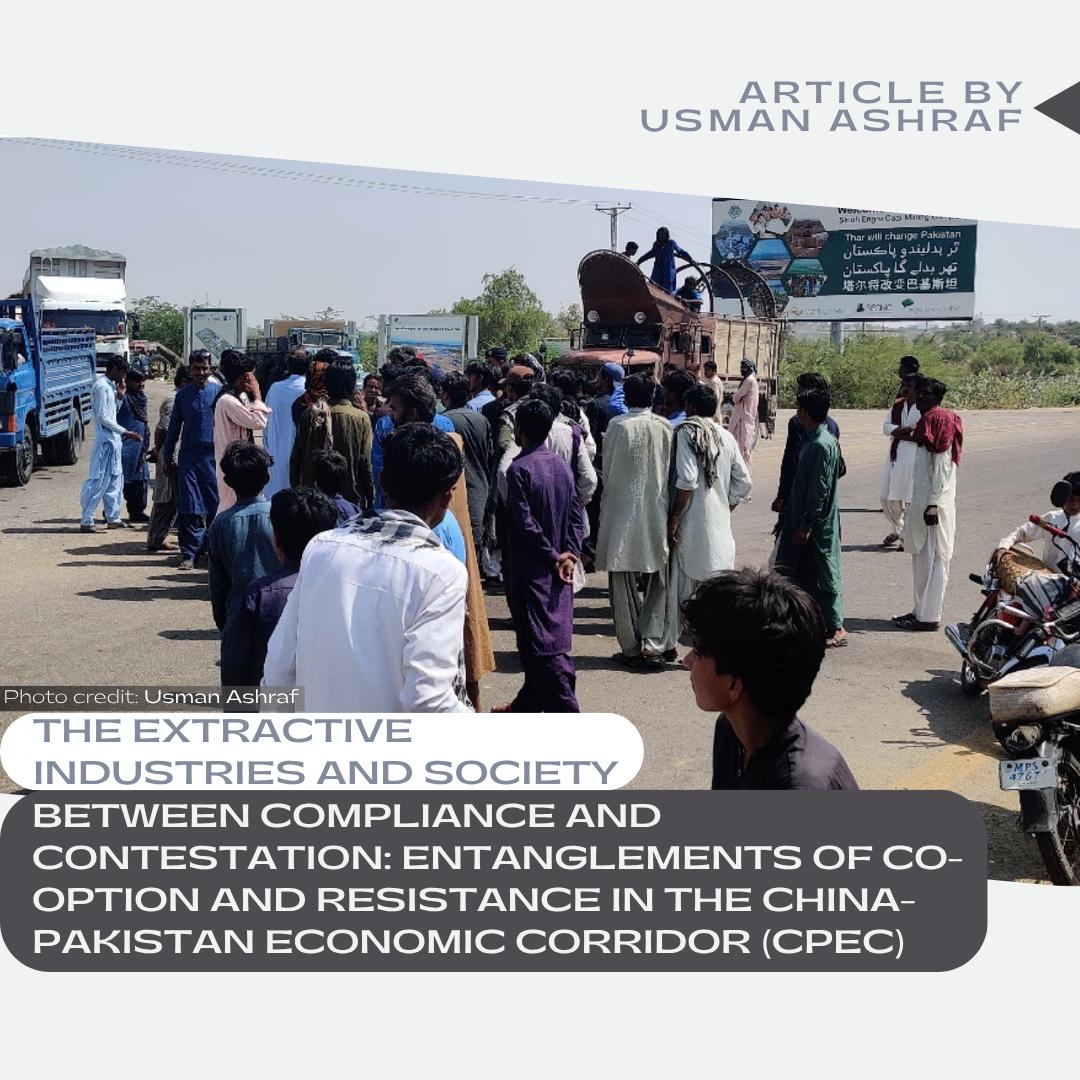
CASAS’ member Usman Ashraf has published this article in The Extractive Industries and Society journal.
Abstract: This research demonstrates that co-option and resistance in extractive sectors are not mutually exclusive, but rather, they are co-produced and coexist as messy entanglements. The type of resistance analyzed here did not seek a mine closure but was instead about (re)negotiating the terms of insertion into the mining enterprise. In such resistance efforts, the on-the-ground realities do not neatly fit into normative conceptualizations of co-option and resistance. Local people tactically switch between co-option and resistance to achieve their objectives, which involve a complex calculus of self-interest, social obligations, (re)negotiations, livelihood improvements, and altruistic acts for the greater good. The key aspect of such resistance is that it uses low-intensity, everyday forms of resistance in which the tactical use of escalation, framing of claims as human rights, and litigation play an important role. My argument is based on qualitative research carried out in the coal mining areas of Tharparkar under Belt and Road Initiative in Pakistan, in 2022 and 2024. The study concludes that a nuanced analysis of different types of mobilizations and their objectives is necessary to differentiate between the workings of different types of resistance
Read his paper here: https://doi.org/10.1016/j.exis.2026.101966
CASAS

The Collective of Agrarian Scholar-Activists from the Global South (CASAS) is a community of Scholar-Activists working in critical agrarian studies.
Leave a Reply