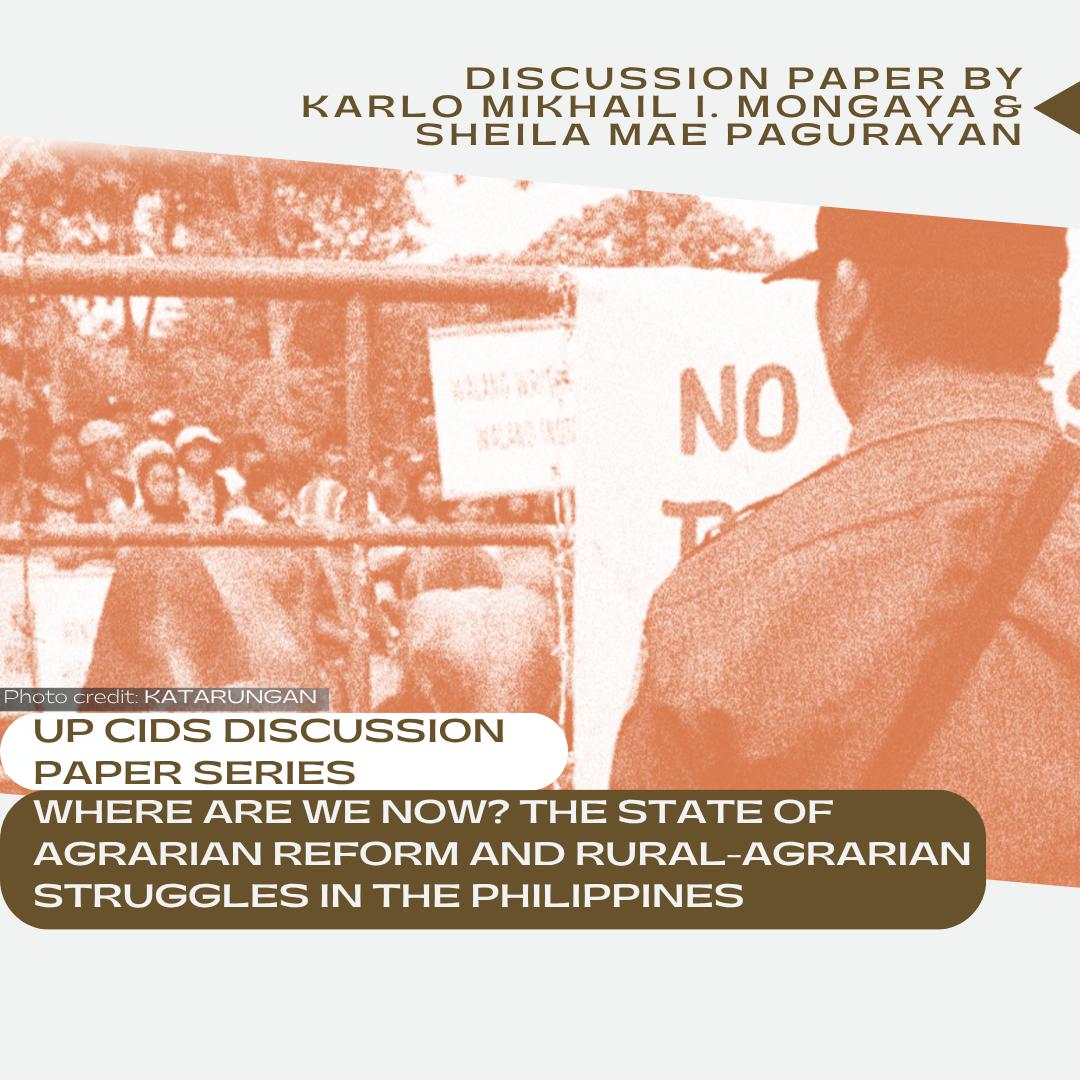
Karlo Mikhail I. Mongaya (CASAS’ member) has published this UP CIDS discussion paper with Sheila Mae Pagurayan.
Abstract; Thirty-eight years after the signing of the Comprehensive Agrarian Reform Program (CARP), the quest to democratize land politics in the Philippine countryside remains fraught with persistent and developing challenges. This paper draws on participatory action research with Kilusan para sa Repormang Agraryo at Katarungang Panlipunan (KATARUNGAN), a national movement of peasants, farmworkers, fisher peoples, Indigenous Peoples, and other rural working peoples, to identify four challenges shaping rural-agrarian struggles in the Philippines today: 1. Reform reversals and land reconcentration; 2. Contestations over conflicting land laws and overlapping claims; 3. Escalating capitalist land grabs and violence; and 4. Worsening scissors crisis and loss of agrarian livelihoods. The movement’s experience reveals that CARP’s focus on land redistribution, while securing significant gains during periods of strong peasant mobilization and coalition-building with state reformers in the 1990s, has been undermined by neoliberal agricultural policies and aggressive reversals of land reform. These developments emphasize the limits of redistribution alone, especially without sustained state support for beneficiaries’ economic viability and ecological regeneration. The paper argues that agrarian reform must transcend the traditional paradigm by grounding it in the holistic framework of the 4Rs: Redistribution, Recognition, Restitution, and Regulation.
Read their full paper here: https://cids.up.edu.ph/discussion_paper/where-are-we-now-state-agrarian-reform-rural-agrarian-struggles-philippines-perspective-contemporary-agrarian-movement
CASAS

The Collective of Agrarian Scholar-Activists from the Global South (CASAS) is a community of Scholar-Activists working in critical agrarian studies.
Leave a Reply