Skip to content
Collective of Agrarian Scholar-Activists from the South

Collective of Agrarian Scholar-Activists from the South

agrarian studies, global south, scholar-activists

Menu
  • Home
  • About
    • About CASAS
    • CASAS Manifesto
    • Position paper: transforming critical agrarian studies
  • Members
    • Who is who in CASAS?
  • Our Work
    • CASAS’ members publications
    • Special Issues
      • JPS Food Sovereignty
    • Conferences
  • Resources
    • News
    • Insights from the ground
    • Multimedia
    • JPS Writeshop
    • ICAS Books Series
  • Contact
Menu

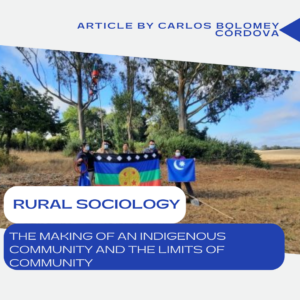
The Making of an Indigenous Community and the Limits of Community: Class Differentiation and Social Ties in Southern Chile

Posted on January 22, 2025June 24, 2026 by CASAS

Carlos Bolomey Córdova, CASAS’ member, has published an article in Rural Sociology.

Abstract: This article seeks to challenge essentialist comprehensions of rural Indigenous communities through examining one particular Mapuche community who were the recipients of a land subsidy. Mapuche people are the largest Indigenous group in Chile. Since the 1990s, the Chilean government, responding to calls for social justice, has purchased land and relocated Mapuche people, mostly landless or almost landless smallholder Indigenous peasants, to areas where they could own land. This study draws on qualitative data gathered from one Mapuche community throughout 2020 and early 2021. It examines the process by which these Mapuche Indigenous people became landowners, and the meanings of this transition for the rural community and households in terms of class differentiation. To this end, the article reflects on key aspects of rural everyday life, such as access to land and machinery. Firstly, it pays attention to the story behind the creation of a new Indigenous community, through analyzing thee ngagement of its members with the institutional path that was created by the Chilean State as a means of addressing Indigenous land struggles. This, in turn, shows how Indigenous communities can also be made while highlighting the disruptions triggered within such communities when engaging with these public schemes. Secondly, the article reflects on how the members of this new Indigenous community regard certain means of production, especially a communal tractor that was acquired through a Chilean State subsidy. In this respect, it shows how agrarian class formation is associated with these rural households’ perceptions regarding their co-owned tractor. Through inves tigating shifting notions of rural Indigenous communities, it is concluded that dynamics of agrarian class differentiation led to community development, as well as demarking the contours of individual rural households within each community.

Read the full article here: https://onlinelibrary.wiley.com/doi/10.1111/ruso.12518

Follow us on our social media
  • Facebook
  • Twitter
  • Instagram

Share this:

  • Share on X (Opens in new window) X
  • Share on Facebook (Opens in new window) Facebook
  • Share on LinkedIn (Opens in new window) LinkedIn
  • Print (Opens in new window) Print

Like this:

Like Loading…

CASAS

Avatar photo

The Collective of Agrarian Scholar-Activists from the Global South (CASAS) is a community of Scholar-Activists working in critical agrarian studies.

Leave a ReplyCancel reply

RECENT POSTS

  • Paguyuban Petani Lahan Pantai Opposing the Neoliberal Policy in the Kulon Progo Coastal Area
  • Movimentos agrários e a luta pela transformação agroalimentar na África Austral
  • Looking back to move forward: historical Agroecology and reciprocity in Ecuador and Bolivia
  • Reproducing Operational Landscapes: The Rock Mining for Indonesia’s New Capital City
  • Private Land Ownership, Race and Class Consideration (1964-1985)

CATEGORIES

  • CASAS' members publications
  • Conferences
  • Insights from the ground
  • JPS Food Sovereignty
  • JPS Writeshop
  • Multimedia
  • News
  • Special Issues
  • Who is who in CASAS?

ARCHIVES

  • June 2026
  • May 2026
  • April 2026
  • March 2026
  • February 2026
  • January 2026
  • December 2025
  • November 2025
  • October 2025
  • September 2025
  • August 2025
  • July 2025
  • June 2025
  • May 2025
  • April 2025
  • March 2025
  • February 2025
  • January 2025
  • December 2024
  • November 2024
  • October 2024
  • September 2024
  • August 2024
  • July 2024
  • June 2024
  • May 2024
  • April 2024
  • March 2024
  • February 2024
  • January 2024
  • December 2023
  • November 2023
  • October 2023
  • September 2023
  • August 2023
  • July 2023
  • May 2023
  • April 2023
  • March 2023
  • February 2023
  • January 2023
  • December 2022
  • November 2022
  • October 2022
  • September 2022
  • August 2022
  • May 2022
  • February 2022
  • July 2021
  • April 2021
  • March 2021
  • February 2021
  • January 2021
  • December 2020
  • November 2020
  • October 2020
  • August 2020
  • July 2020
  • June 2020
  • May 2020
  • April 2020

RECENT COMMENTS

  1. Mercedes Ejarque on Call for applicants: Writeshop 2026
  2. shemilkalayath on Call for applicants: Writeshop 2026
  3. Why Palestine is a feminist and an anti-colonial issue  | ROAPE on Palestine: Reaffirming our commitment for a solidarity-based network of agrarian studies global-south scholars
  4. Mercedes Ejarque on Call for applicants: Writeshop 2026
  5. tranquil865a3fc7cd on Call for applicants: Writeshop 2026

TAGS

Africa Agrarian Change agribusiness agriculture Agroecology Argentina Asia authoritarianism Bolivia Brazil Chile China climate change COHD Colombia conflict COVID-19 Critical Agrarian Studies Development Studies Ecuador Extractivism food sovereignty gender Global South India Indonesia JPS land rush Latin-america mexico Middle East Mozambique pandemic pastoralism scholar activism Social Movements social reproduction South Africa South America sustainability Turkey Violence vulnerability writeshop Zimbabwe

CONNECT WITH CASAS

RSSTwitterFacebookLinkedin

SUSCRIBE BY EMAIL

CASAS SOUTH FACEBOOK

Tweets by Casas_South

Meta

  • Log in
  • Entries feed
  • Comments feed
  • WordPress.org
©2026 Collective of Agrarian Scholar-Activists from the South | Built using WordPress and Responsive Blogily theme by Superb
%d