
India
-
Who is who in CASAS: Amrita Sharma

Amrita Sharma is an Associate Professor at O P Jindal Global University in Haryana, India. She teaches political studies and works across political economy, political anthropology, political ecology, critical agrarian studies, and political geography. Her research examines the everyday politics of conflicts, resistance, and social movements, with a sustained focus on sovereignty, development, extractivism, nationalism,…
-
New Waves of Sugarcane Commercialisation: Unequal Forms of Exchange in a North Indian Village
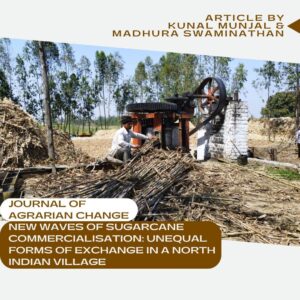
CASAS’ member Kunal Munjal has published this article with Madhura Swaminathan in the Journal of Agrarian Change. Abstract: In Uttar Pradesh, the largest producer of sugarcane in India, the crop is grown on family farms and marketed under an outgrower model with state regulation. Higher productivity and production from a new ‘wonder’ variety, an expansion…
-
Does “Feminization U Hypothesis” Hold? A Discussion on Women’s Work Participation in Rural India
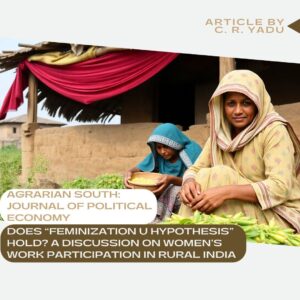
CASAS’ member C. R. Yadu has published this paper in Agrarian South: Journal of Political Economy. Abstract: The Nobel Prize in Economics awarded to Claudia Goldin in 2023 has renewed attention on issues of women’s work. In this context, this article critically revisits the debate on the declining participation of women in the rural labor…
-
Designing Gender-Responsive Climate Information Services: Insights from Evidence

Aayushi Malhotra (CASAS’ member) has published this report in the series CGIAR Gender Equality and Inclusion with Gerald Katothya, Ranjitha Puskur and Niyati Singaraju. Abstract: The CGIAR Gender Equality and Inclusion (GEI) Accelerator enables transformative research on gender in agriculture and food systems, promoting equitable, sustainable, productive and climate-resilient outcomes. The Accelerator prioritizes the generation…