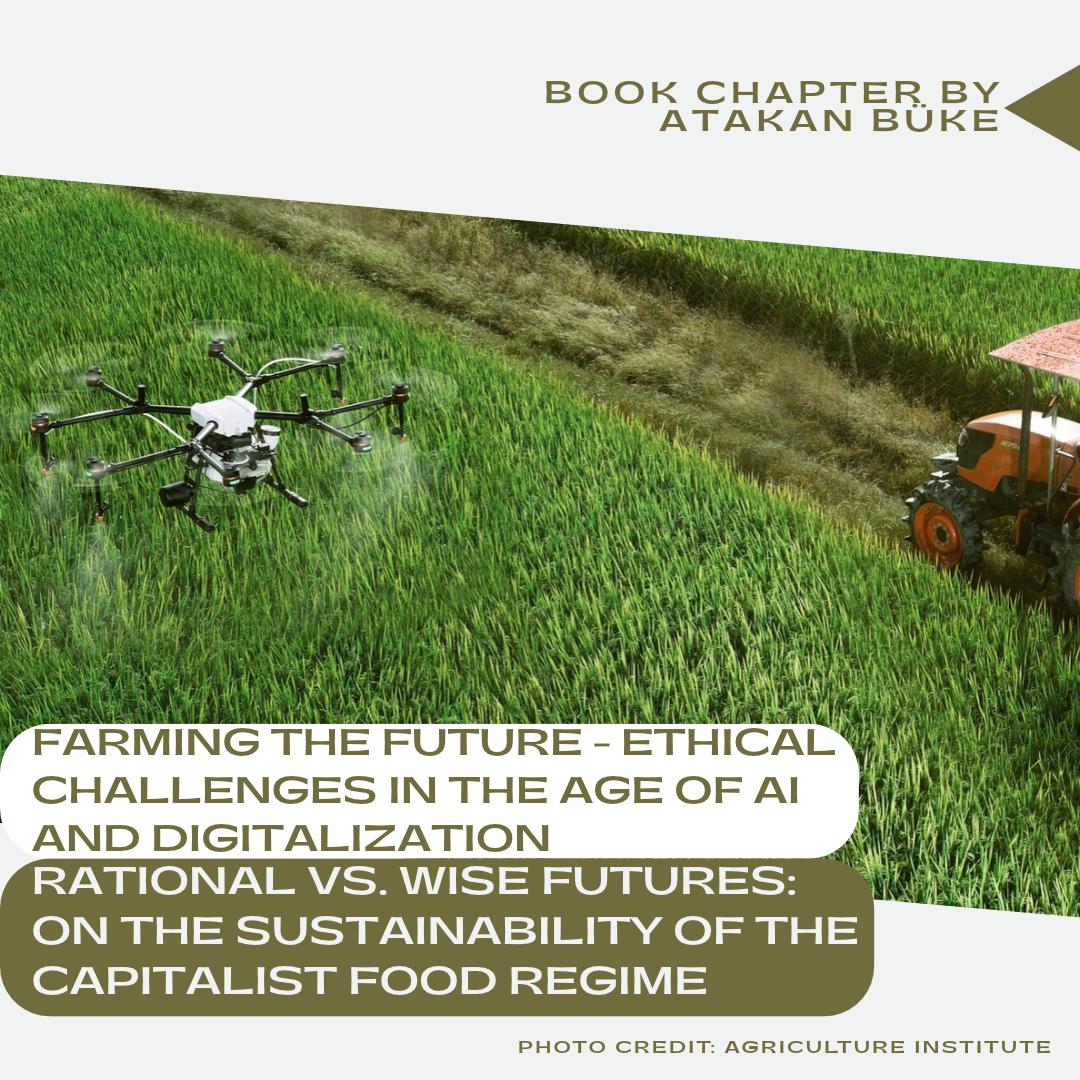
CASAS’ member Atakan Büke has published this book chapter in the book Farming the Future – Ethical Challenges in the Age of AI and Digitalization.
Abstract: This study argues that ongoing contestations over the sustainability of the capitalist food regime can be framed as a struggle between ‘rational’ and ‘wise’ futures, the two prevailing counter-tendencies regarding the future of agriculture and food. On the one hand, corporate-based bio-industrial approaches present the issue as a question of rationalising agrifood relations: fine-tuning systemic imbalances through cutting-edge technologies (e.g., genome editing, digital agriculture, etc.), complemented by political and socio-cultural restructuring (e.g., so-called comprehensive legislative frameworks, awareness-raising, etc.). On the other hand, alternative socio-ecological imaginaries and practices are proliferating, as reflected in concepts such as agroecology, food sovereignty, peasant agriculture, and alternative food networks. These alternatives – by criticising mainstream rationalisation attempts as capitalist, industrial, modernist, Euro-Atlantic-centric, patriarchal, and more – highlight the significance of the wisdom implicit in peasant and indigenous knowledges and traditional agrarian and food practices. As those mainstream corporate attempts aim to sow rational futures by harvesting the previous successes of a developmentalist past, they appear as the most progressive, scientific, and incontestable solutions to our problems. In contrast, yet in connection with this, as those alternative imaginaries try to harvest wise futures by re-sowing socio-culturally and ecologically sustainable and inclusive pasts, they appear romantic, not only in their conceptions of our past but also in their attempts to address the escalating agrifood problems jeopardising the future, such as feeding the growing world population. By situating the divide between rational and wise futures within the socio-historical and ecological tendencies and contradictions of the capitalist food regime (i.e., planetary agriculturalization and de-agriculturalization of food), this study argues that neither the rationalist camp is as progressive as it claims to be, nor are the alternative imaginaries as romantic as they seem.
Read the chapter: https://doi.org/10.1163/9789004776630-027
CASAS

The Collective of Agrarian Scholar-Activists from the Global South (CASAS) is a community of Scholar-Activists working in critical agrarian studies.
Leave a Reply