New publication alert!
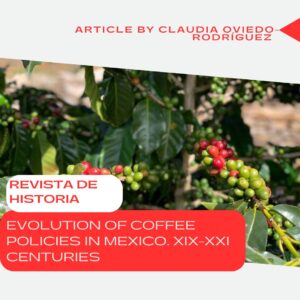
Claudia Oviedo-Rodriguez, CASAS’ member, has just published an article in Revista de Historia, a history journal.
Abstract:
This paper characterizes the evolution of Mexican coffee policies, addressing how
the state’s interest and its mechanisms for supporting coffee production have changed
significantly over time. Three major phases of coffee policies were identified. First,
during the late XIX and early XX centuries, the state was focused on expanding the
number of hectares for coffee and facilitating land acquisition by large-scale farmers.
Second, from 1958 to 1989, the state was interested in expanding coffee plantations and
increasing productivity with higher-yield varieties and fertilizer. The state played a strong
regulatory role in overseeing coffee prices and collecting farmers’ harvests; during this
phase, small-scale farmers were the main target of support. Third, from 1989 to 2018, the
state continued to promote increased productivity, but it also began to focus on improving
quality. While small-scale farmers continued to be the principal target of support, the state
significantly reduced its intervention in the coffee sector and primarily aided small-scale
farmers through programs supplying plants and fertilizer.
Read the full article here
Mercedes Ejarque

Mercedes Ejarque is a researcher at the National Institute of Agricultural Technology (INTA). She is also Professor of Rural Sociology in a Master Program at the University of Buenos Aires (UBA). She holds a Master’s Degree in Social Research and a PhD in Social Sciences from the University of Buenos Aires. Her research focuses on society – nature relations around agrarian activities, social constructivism of environmental problems and political ecology in Patagonia. She has also published about methodological issues in agrarian research, rural labour markets and rural-urban tendencies.
Leave a Reply