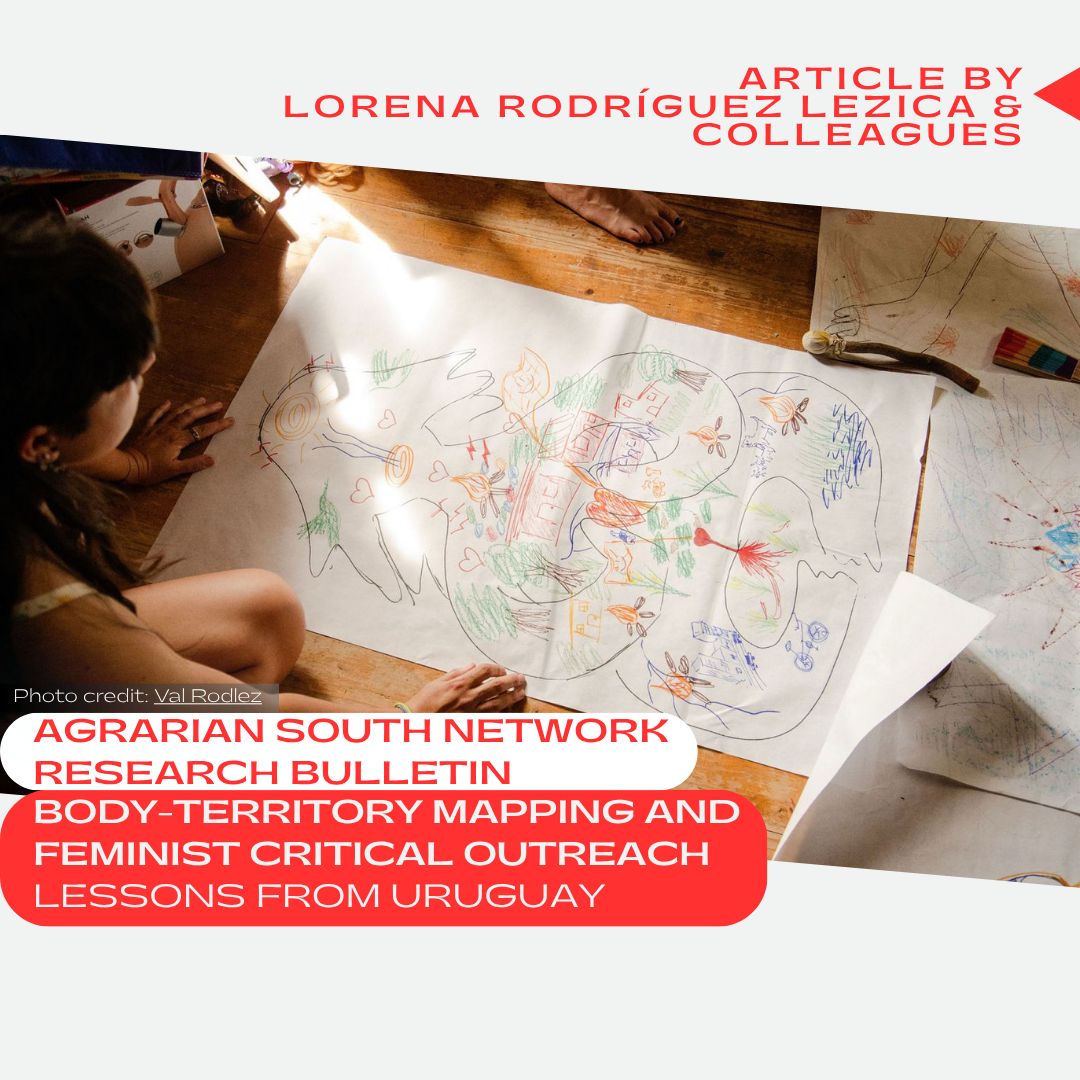
New publication alert! CASAS member Lorena Rodríguez Lezica has recently published this article in Agrarian South Network Research Bulletin with colleagues Gabriela Veras Iglesias, Nat Tommasino Comesaña, and Alicia Migliaro González.
This contribution draws on a feminist experience developed in 2025 as part of the Omega Resilience Awards initiative and rooted in a broader process of university extension and collaborative knowledge production with grassroots collectives across Uruguay. Using body-territory mapping as a collective feminist methodology, we examine how women narrate and make visible the impacts of land and water dispossession, environmental contamination, and multiple forms of violence, while highlighting the networks of care, resistance, and solidarity through which life is sustained in their territories. This piece contributes to broader debates on territorial defense, feminist struggles, and alternatives to extractivist development models in the Global South, while offering insights into feminist methodologies that foster collective reflection, situated knowledge production, and processes of resistance and collective care.
Abstract:
In Uruguay, a series of transformations have taken place that threaten the sustainability of family, peasant, and community-based agriculture, agroecology, and careful ways of inhabiting territories, in the face of the dominant extractivist model. These are contexts in which extractivist practices have caused varying degrees of harm to the fabric of life—impacting communities and the ways in which relationships between human and more-than-human lives are built. Focusing on social struggles in recent years, we observe that resistance to dispossession and structural crises is becoming increasingly central. In particular, the leading role of women has become more visible in defending life, the health of territories, land, and water—denouncing contamination and poisoning in the hands of agribusiness, as well as land concentration in the hands of real estate speculation. Our aim has been to make visible the ways in which life is sustained and territories are inhabited through the networks woven by the women with whom we have been working. We understand these networks as ties and spaces of encounter built throughout their lives.
Read their full paper here: https://www.agrariansouth.org/wp-content/uploads/2026/06/ASN-RB-April-June-2026_1.pdf
CASAS

The Collective of Agrarian Scholar-Activists from the Global South (CASAS) is a community of Scholar-Activists working in critical agrarian studies.
Leave a Reply