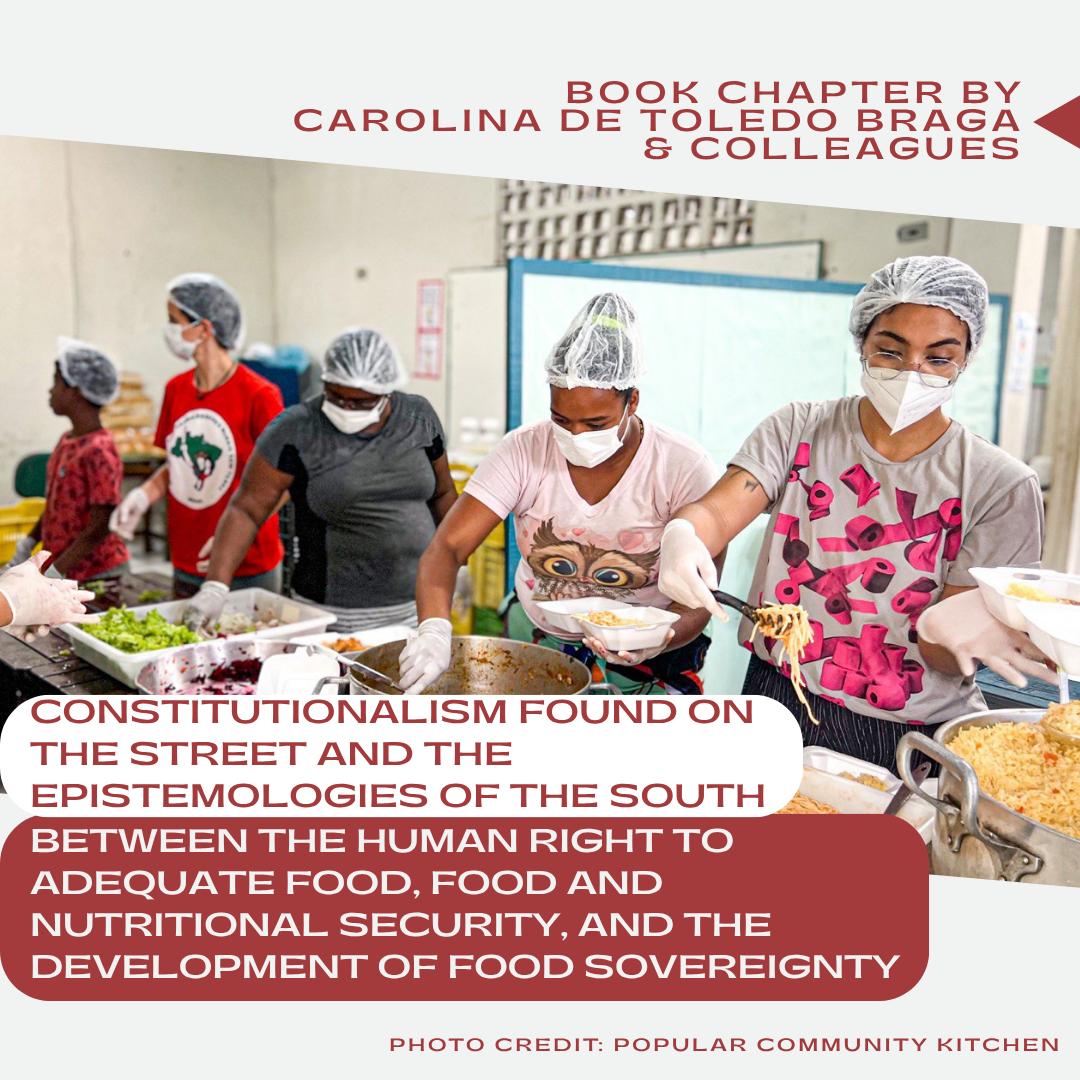
CASAS’ member Carolina De Toledo Braga has published this chapter with Renata Pinho Studart Gomes; Pedro Henrique Izidro da Silva; David Guerra Souza; Alef Henrique Guerra Vieira in the book ‘Constitutionalism found on the street and the epistemologies of the South’.
Abstract: This essay presents an analysis of the Human Right to Adequate Food (DHAA) and community soup kitchens in the Brazilian context, examining their relevance to food justice and the fight against hunger. Firstly, we establish the HRFA as a fundamental right guaranteed at both international and national levels, before going on to distinguish between the concepts of Food Security (focused on regular access and quantities guaranteed by the State) and Food Sovereignty (emphasising the right of peoples to define their own food systems and modes of production). The text also explores recent public policies, such as the Cozinha Solidária Programme and the Paul Singer Training Programme, which point to the possibility of institutionalising these practices based on community self-organisation and the strengthening of working-class neighbourhoods. Finally, the essay discusses community solidarity kitchens as social practices and insurgent social technologies that not only provide food but also promote collective organisation and build food sovereignty, in line with the theoretical perspective of ‘Law Found on the Street’.
CASAS

The Collective of Agrarian Scholar-Activists from the Global South (CASAS) is a community of Scholar-Activists working in critical agrarian studies.
Leave a Reply