
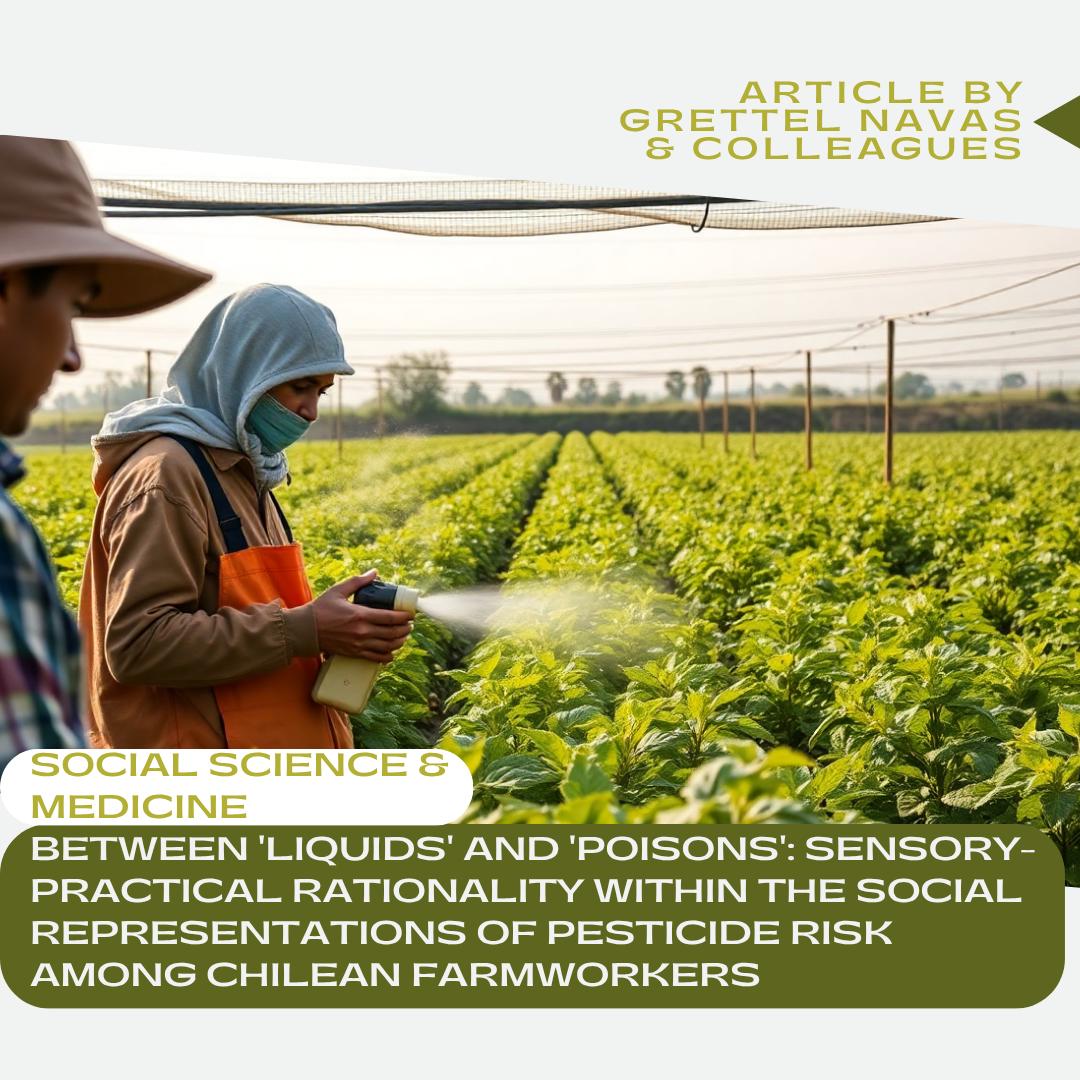
CASAS’ member Grettel Navas has published this article with Boris Lucero, María Teresa Muñoz-Quezada, Rafael Junqueira Buralli and Paula Ceballos in Social Science & Medicine.
Abstract: Occupational pesticide exposure is a significant global health concern for agricultural workers, and research aimed at addressing it has long been shaped by the “knowledge deficit” framework, which dominates pesticide safety research and treats workers as rational actors who lack adequate information. This framing fails to account for how risk perceptions are socially organised, culturally reproduced, and structurally embedded within specific occupational contexts. This study applies Abric’s Central Core Theory (CCT) of Social Representations to examine how 20 Chilean farmworkers in the Maule Region construct and organise their understanding of occupational pesticide exposure. Using open-ended interviews analysed through Rodríguez’s (2007) qualitative methodology, central and peripheral elements were identified across four representational domains: pesticide identity and risk, routes of exposure, prevention conditions, and health and environmental effects. The analysis suggests a coherent representational system organised around a paradoxical central core: pesticides are simultaneously objectified as “liquids”, normalising their use as routine agricultural matter, and recognised as “poison,” acknowledging their danger. The functional logic sustaining this paradox is characterised as sensory-practical rationality: risk is perceived, graded, and managed according to sensory detectability rather than toxicological magnitude, producing a stable pattern of conditional risk acceptance. Sensory cues structure how exposure routes are represented (visible oral and inhalation risk versus the invisible dermal hazard), anchor the hierarchy of health effects (from immediately witnessed poisoning to intergenerational malformation and cancer), and constrain the salience of environmental harm to what can be materially apprehended. This representational architecture is not a product of ignorance or cognitive error, but rather a culturally embedded and structurally reproduced form of lay expertise shaped by precarious labour conditions, limited regulatory enforcement, and export-market compliance pressures. The findings carry implications for how occupational health interventions are designed and how risk communication can engage invisible cumulative hazards beyond the limits of sensory-practical knowledge.
Read their article: https://doi.org/10.1016/j.socscimed.2026.119561
CASAS

The Collective of Agrarian Scholar-Activists from the Global South (CASAS) is a community of Scholar-Activists working in critical agrarian studies.
Leave a Reply