
Asia
-
Talking Indonesia: Indonesian ecological thinking

CASAS’ member Fathun Karib has been interviewed by Jemma Purdey, Elisabeth Kramer, Tito Ambyo, Jacqui Baker, and Clara Siagian for Indonesia at Melbourne about a recent book. Bacaan Bumi is a book that emerged from conversations sparked by a groundbreaking summer school on critical environmental history at Gadjah Mada University—Indonesia’s first university program of its…
-
Painful hopes? The health and well-being impacts of land expropriation in Chinese villages

Guolin Gu (CASAS’ member) has published with Wen Fan an article in Land Use Policy. Abstract: Debates over state-led land expropriation in rural China often center on whether it constitutes victimization or empowerment. This paper reconciles these competing narratives by examining the health and well-being impacts of land expropriation on two groups: (1) individuals who…
-
Failed business or controlling resources?: agricultural land-based investments in Lao PDR

Vong Nanhthavong, CASAS’ member, has published this article in The Journal of Peasant Studies Abstract: Many land deals in the Global South are initiated and sustained, while others fail financially but maintain control over land and resources. These failed deals—and their implications for peasant well-being—remain undervalued in debates on the global land rush and land-grab…
-
Reading agrarian transformation through literature: moral economy, political economy, and caste in 1950s Punjab in Gurdial Singh’s Marhi da Deeva
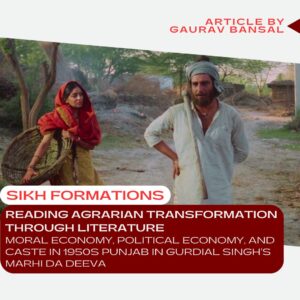
Gaurav Bansal has published this article in the journal Sikh Formations. Abstract: This article examines the socio-economic transformations of 1950s rural Punjab through Gurdial Singh’s seminal novel Marhi da Deeva (1964). By putting moral economy framework in conversation with political economy, this essay reveals how the gradual transition from semi-feudal relations to capitalist tendencies had fundamentally reshaped…