CASAS’ members publications
-
CASAS Research Talks: Episode 2
In line with our manifesto principles of engaging in critical agrarian debates, strengthening the co-production of knowledge and broadening the scope of dissemination, we are launching this new initiative: CASAS’ Research Talks. This podcast invites our members to address the key issues of their scholar-activist practice in a modern and popular format. The Second Episode…
-
Rethinking Agrifood Systems in (Post-)Pandemic Times: Moving Beyond Crisis and Recovery Narratives
Atakan Büke, CASAS’ member, has published an article with José Duarte Ribeiro, Hilde Bjorkhaug & Sarah Ruth Sippel in The International Journal of Sociology of Agriculture and Food. Abstract: The COVID-19 pandemic brought about significant changes in the global agri-food system. It disrupted food supply chains, created labour shortages, instilled fears of food insecurity, and…
-
Whose story is your data telling? Top 10 reads on gender-disaggregated data
Aayushi Malhotra, CASAS’ member, has published this article in Gender Impact Platform. The article provides a series of recommended reading lists, which ca be starting points for researchers, students, practitioners and others looking to dive deeper into research on gender and a wide variety of topics. This list takes a closer look at recommended reading…
-
Proposed revisions to a Mozambican land law threaten environmental sustainability and poverty reduction
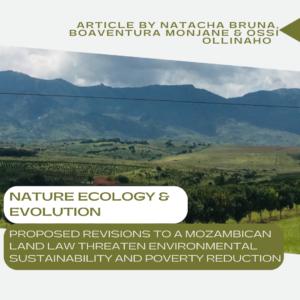
CASAS’ members Natacha Bruna & Boaventura Monjane has published with Ossi I. Ollinaho an article in Nature ecology & evolution. You can read the full text here: https://doi.org/10.1038/s41559-025-02665-z