
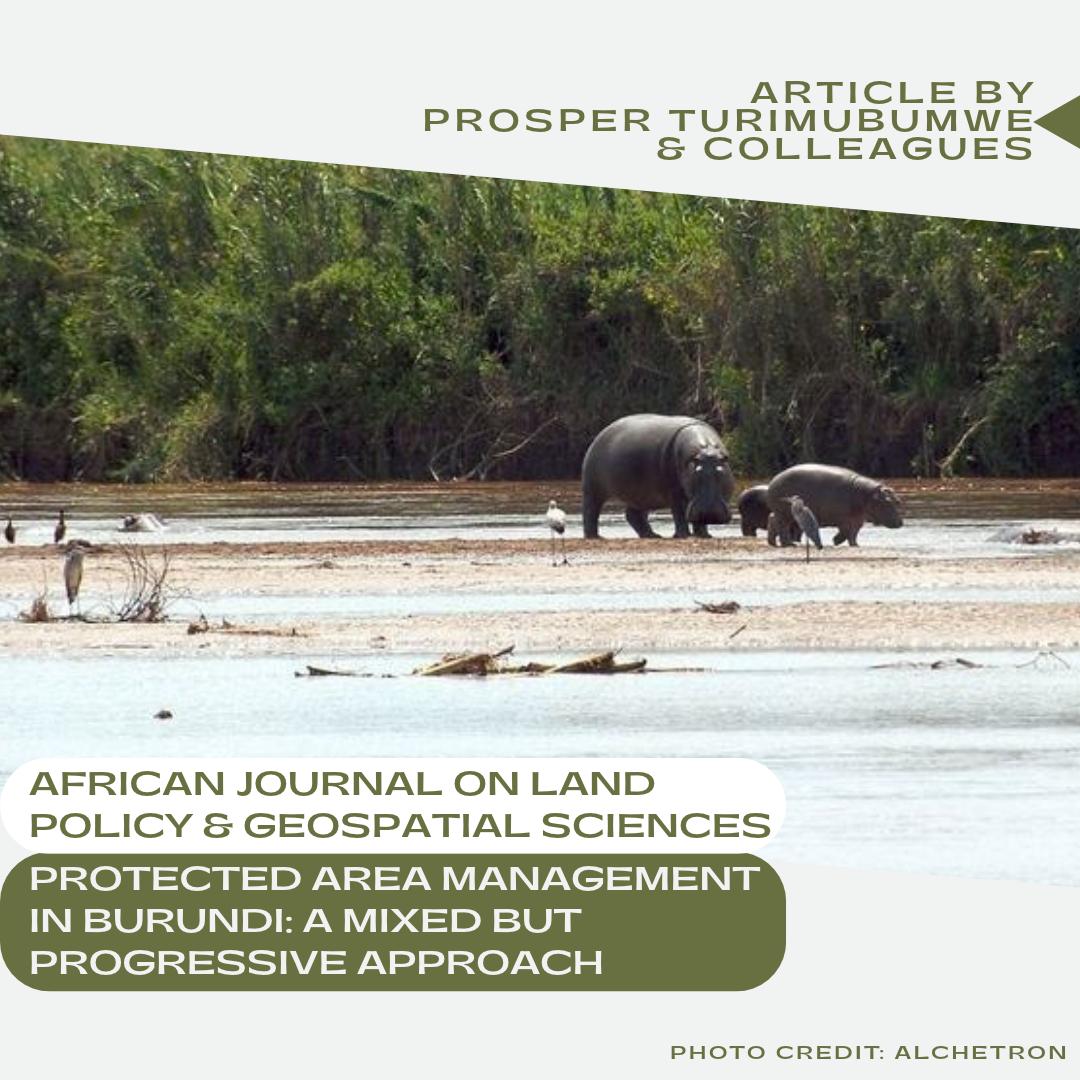
Prosper Turimubumwe (CASAS’ member) has published this article with Henri Kabanyegeye & Didier Mbarushimana in the African Journal on Land Policy & Geospatial Sciences.
Abstract: Protected areas (PAs) are cornerstones of national and international conservation strategies. They are a key tool for protecting biodiversity and the services it provides to human societies. The aim is to protect forests and wildlife from overexploitation. Burundi is one of the few African countries where no national parks were established during the colonial era, even though all forests became official reserves under Belgian colonial authority in 1933. The objective of this work is to assess the state of protected area management in Burundi in order to protect them against the various forms of degradation that threaten them. Several methods were used in this study. These included a review of existing national and international documents on the management of protected areas in Burundi. Field surveys and interviews were also conducted, particularly with rangers and residents living near certain protected areas, notably Kibira, Ruvubu, and Rusizi National Parks. Additional interviews were conducted with officials from the Burundian Office for Environmental Protection (OBPE) to gain a broader perspective. The 14 PAs of Burundi cover 157,923 hectares, representing 5.6% of the national territory, and harbor remarkable biodiversity. They are also exposed to anthropogenic threats and pressures, including poaching, deforestation, bushfires, the expansion of shifting cultivation, mining, and urbanization. To manage and protect PAs, Burundi enacted a law in 2011 defining the legal framework for protected areas, including the conditions and procedures for their creation and management. Furthermore, these PAs, whose management focuses on the key animal and plant species for each PA as well as endangered species, fall under the responsibility of the OBPE. Finally, the OBPE and several other institutions are involved in the conservation of PAs and their biological resources.
Read the full article here: https://doi.org/10.48346/IMIST.PRSM/ajlp-gs.v9i7.65355
CASAS

The Collective of Agrarian Scholar-Activists from the Global South (CASAS) is a community of Scholar-Activists working in critical agrarian studies.
Leave a Reply