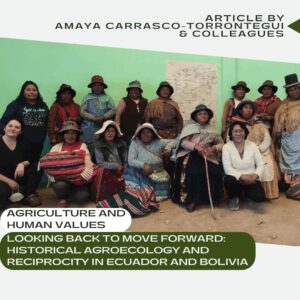
CASAS’ member Amaya Carrasco-Torrontegui has published this article with Carlos Andrés Gallegos-Riofrío, Ernesto Méndez, María Quispe, Mabel Pintag, Renato Pardo Valenzuela, Milka Caranqui, Nils McCune, Gabriela Bucini, Teresa Mares & Colin Anderson in Agriculture and Human Values.
Abstract:
Broad analyses of social change often overlook the lived experiences of rural Indigenous communities. This paper connects historical agroecology with Participatory Action Research, through collective memory and historical analysis, to examine agroecological transitions in Indigenous communities in Ecuador and Bolivia. The study uses decolonial inquiry to investigate how historical events and sociocultural dynamics shape contemporary food systems, employing river-of-life exercises (with 25 and 27 participants, respectively), 15 interviews per country, participant observation, and archival research. Results highlight that reciprocity-based customary institutions guide social and ecological dynamics shaping landscape and connecting the local to broader solidarity economies. Findings reveal that Caliata adopts a transformative, self-determined path, while Chigani Alto follows an incremental, reformist trajectory within institutional structures. These cases confirm that agroecological transitions are historically grounded and culturally rooted, the ancestral “past” is present. We propose that this approach to Historical Agroecology provides a replicable, culturally appropriate framework for guiding food system transitions.
Read their full article here: https://doi.org/10.1007/s10460-026-10865-x
CASAS

The Collective of Agrarian Scholar-Activists from the Global South (CASAS) is a community of Scholar-Activists working in critical agrarian studies.
Leave a Reply