Skip to content
Collective of Agrarian Scholar-Activists from the South
Menu
  • Home
  • About
  • Who is who in CASAS?
  • Resources
    • CASAS’ members publications
    • ICAS Books Series
  • Writeshops
  • Contacts
  • Network
Menu

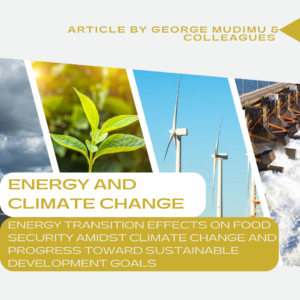
Energy transition effects on food security amidst climate change and progress toward sustainable development goals

Posted on December 11, 2025December 5, 2025 by CASAS

George Mudimu (CASAS’ member) has published with Phemelo Tamasiga, Valentine Munyaradzi Dzingai, Helen Onyeaka, Rose Daphnee Tchonkouang, Kehinde Favour Siyanbola & Ulakom Genesis an article in Energy and Climate Change.

Abstract: Transitioning to net-zero societies affects how energy is produced and consumed, with consequences for food security. Through a systematic review of 43 peer-reviewed studies that follow the PRISMA protocol, results reveal that renewable energy can enhance agricultural productivity by reducing operational costs, increasing efficiency in irrigation and processing, and providing reliable access to energy. However, challenges exist, including competition for land and water resources between renewable energy projects and food production, high upfront costs of clean energy technologies, limited access to credit facilities, and institutional bottlenecks. To overcome these challenges, recommended policies include offering subsidies and financial incentives to make clean energy more affordable for farmers, as well as providing education and training to support the adoption of sustainable practices. Furthermore, promoting collaboration between the public and private sectors is crucial to stimulate investment in renewable energy infrastructure. Moreover, these policies must be designed for specific national circumstances. High-income or upper-middle-income countries can deploy capital-intensive agrivoltaic and biogas technologies via concessional finance. In contrast, low-income settings should prioritize low-cost, decentralized solar pumps and off-grid dryers to build farmer confidence and trust. Countries with stronger regulatory frameworks and secure land tenure systems are better equipped to support large-scale renewable energy projects. At the same time, regions with weaker governance tend to benefit most from community-owned mini-grids. The mapping of policy options onto economic, institutional, and agro-ecological dimensions provides a nuanced, context-sensitive framework to guide equitable and effective energy transitions in diverse agricultural landscapes.

Read their article here: https://doi.org/10.1016/j.egycc.2025.100222

Follow us on our social media
  • Facebook
  • Twitter
  • Instagram

Share this:

  • Twitter
  • Facebook
  • LinkedIn
  • Print

Like this:

Like Loading...

CASAS

Avatar photo

The Collective of Agrarian Scholar-Activists from the Global South (CASAS) is a community of Scholar-Activists working in critical agrarian studies.

Leave a ReplyCancel reply

Recent Posts

  • Talking Indonesia: Indonesian ecological thinking
  • Radical ecological economics: A paradigm from the global south
  • The “Pesticide Chip”: Chemical Legacies and Agrarian Futures in Costa Rica
  • Painful hopes? The health and well-being impacts of land expropriation in Chinese villages
  • Responsiveness of urban land administration systems in managing wetlands in the rapidly urbanizing Bujumbura city, Burundi

Categories

  • Blogs (152)
  • CASAS Members (36)
  • Multimedia (4)
  • News (168)
  • Resources (262)
    • CASAS' members publications (237)
  • Who is who in CASAS? (38)
  • Writeshops (9)

Archives

  • March 2026 (3)
  • February 2026 (7)
  • January 2026 (11)
  • December 2025 (7)
  • November 2025 (12)
  • October 2025 (9)
  • September 2025 (9)
  • August 2025 (7)
  • July 2025 (7)
  • June 2025 (9)
  • May 2025 (13)
  • April 2025 (7)
  • March 2025 (12)
  • February 2025 (15)
  • January 2025 (12)
  • December 2024 (10)
  • November 2024 (7)
  • October 2024 (8)
  • September 2024 (8)
  • August 2024 (8)
  • July 2024 (9)
  • June 2024 (8)
  • May 2024 (12)
  • April 2024 (5)
  • March 2024 (7)
  • February 2024 (9)
  • January 2024 (3)
  • December 2023 (13)
  • November 2023 (4)
  • October 2023 (3)
  • September 2023 (14)
  • August 2023 (2)
  • July 2023 (12)
  • May 2023 (5)
  • April 2023 (9)
  • March 2023 (5)
  • February 2023 (10)
  • January 2023 (7)
  • December 2022 (2)
  • November 2022 (7)
  • October 2022 (3)
  • September 2022 (2)
  • August 2022 (3)
  • May 2022 (2)
  • February 2022 (1)
  • July 2021 (2)
  • April 2021 (3)
  • March 2021 (3)
  • February 2021 (2)
  • January 2021 (1)
  • December 2020 (1)
  • November 2020 (4)
  • October 2020 (3)
  • August 2020 (4)
  • July 2020 (1)
  • June 2020 (3)
  • May 2020 (4)
  • April 2020 (5)

Recent Comments

  • Mercedes Ejarque on Call for applicants: Writeshop 2026
  • tranquil865a3fc7cd on Call for applicants: Writeshop 2026
  • Important new launch: CASAS Research Talks – Collective of Agrarian Scholar-Activists from the South on Who is who in CASAS? George T. Mudimu
  • El acaparamiento de agua por parte de la industria alimentaria deja a las comunidades sin una gota | afriKando on Agrarian workers’ long struggle for labor justice in Peru: progress and an uncertain future
  • Mercedes Ejarque on Call for Applicants: 5th Writeshop in Critical Agrarian Studies and Scholar-Activism

Tags

Africa agribusiness agriculture Agroecology Argentina Asia authoritarianism Bolivia Brazil Chile China climate change COHD collective action Colombia conflict COVID-19 Critical Agrarian Studies Development Studies Ecuador Extractivism food sovereignty gender Global South India Indonesia JPS land grabbing Land reform land rush Latin-america mexico pandemic pastoralism political ecology scholar-activism Social Movements social reproduction South Africa South America sustainability Turkey Violence writeshop Zimbabwe

Connect with CASASouth

RSSTwitterFacebook

Subscribe to CASASOUTH by Email

Subscribe to casasouth.org by Email

CASASouth Facebook

CASASouth Facebook
Tweets by Casas_South

Meta

  • Log in
  • Entries feed
  • Comments feed
  • WordPress.org
©2026 Collective of Agrarian Scholar-Activists from the South | Built using WordPress and Responsive Blogily theme by Superb
%d