Skip to content
Collective of Agrarian Scholar-Activists from the South
Menu
  • Home
  • About
  • Who is who in CASAS?
  • Resources
    • CASAS’ members publications
    • ICAS Books Series
  • Writeshops
  • Contacts
  • Network
Menu

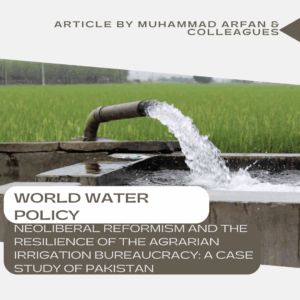
Neoliberal Reformism and the Resilience of the Agrarian Irrigation Bureaucracy: A Case Study of Pakistan

Posted on September 25, 2025October 6, 2025 by CASAS

Muhammad Arfan, CASAS’ member, has published this article in World Water Policy with Muhammad Ali, Asmat Ullah and Kamran Ansari.

Abstract: In 1980, the World Bank began to promote participatory irrigation management (PIM) reforms to overcome disparities in the distribution of public irrigation water for agricultural uses. Yet, in Pakistan as in other countries, PIM was unable to achieve its objectives of equitable resource distribution and financial sustainability. This paper examines how the neoliberal understanding of citizens’ participation/participatory development as demonstrated in PIM fails because its underlying theory of change overlooks power asymmetry issues, institutional politics, and farmers’ engagement processes. We argue that traditional irrigation bureaucracy, donor agency technocrats, and depoliticized participatory development approach intentionally or unintentionally ignore the muted voices of small and landless peasants in the reform process. Under such circumstances, reform cannot generate hydro-solidarity, trust, and collective action from below. Moreover, the irrigation bureaucracy only mimics the institutions of participation under an externally assisted push because the PIM model was never adequately tested and implemented. We argue that without active farmers’ agency—small and landless peasants, these paper organizations cannot create multilevel accountability in irrigation management. We elucidate an important but under-theorized factor contributing to these failures: depoliticized irrigation management transfer processes that fail to redistribute social power. Donor articulations of the PIM “theory of change” do not make explicit that a shift in social power—not just management authority and responsibility—is necessary.

Check their article: https://doi.org/10.1002/wwp2.70030

Follow us on our social media
  • Facebook
  • Twitter
  • Instagram

Share this:

  • Twitter
  • Facebook
  • LinkedIn
  • Print

Like this:

Like Loading...

CASAS

Avatar photo

The Collective of Agrarian Scholar-Activists from the Global South (CASAS) is a community of Scholar-Activists working in critical agrarian studies.

Leave a ReplyCancel reply

Recent Posts

  • Talking Indonesia: Indonesian ecological thinking
  • Radical ecological economics: A paradigm from the global south
  • The “Pesticide Chip”: Chemical Legacies and Agrarian Futures in Costa Rica
  • Painful hopes? The health and well-being impacts of land expropriation in Chinese villages
  • Responsiveness of urban land administration systems in managing wetlands in the rapidly urbanizing Bujumbura city, Burundi

Categories

  • Blogs (152)
  • CASAS Members (36)
  • Multimedia (4)
  • News (168)
  • Resources (262)
    • CASAS' members publications (237)
  • Who is who in CASAS? (38)
  • Writeshops (9)

Archives

  • March 2026 (3)
  • February 2026 (7)
  • January 2026 (11)
  • December 2025 (7)
  • November 2025 (12)
  • October 2025 (9)
  • September 2025 (9)
  • August 2025 (7)
  • July 2025 (7)
  • June 2025 (9)
  • May 2025 (13)
  • April 2025 (7)
  • March 2025 (12)
  • February 2025 (15)
  • January 2025 (12)
  • December 2024 (10)
  • November 2024 (7)
  • October 2024 (8)
  • September 2024 (8)
  • August 2024 (8)
  • July 2024 (9)
  • June 2024 (8)
  • May 2024 (12)
  • April 2024 (5)
  • March 2024 (7)
  • February 2024 (9)
  • January 2024 (3)
  • December 2023 (13)
  • November 2023 (4)
  • October 2023 (3)
  • September 2023 (14)
  • August 2023 (2)
  • July 2023 (12)
  • May 2023 (5)
  • April 2023 (9)
  • March 2023 (5)
  • February 2023 (10)
  • January 2023 (7)
  • December 2022 (2)
  • November 2022 (7)
  • October 2022 (3)
  • September 2022 (2)
  • August 2022 (3)
  • May 2022 (2)
  • February 2022 (1)
  • July 2021 (2)
  • April 2021 (3)
  • March 2021 (3)
  • February 2021 (2)
  • January 2021 (1)
  • December 2020 (1)
  • November 2020 (4)
  • October 2020 (3)
  • August 2020 (4)
  • July 2020 (1)
  • June 2020 (3)
  • May 2020 (4)
  • April 2020 (5)

Recent Comments

  • Mercedes Ejarque on Call for applicants: Writeshop 2026
  • tranquil865a3fc7cd on Call for applicants: Writeshop 2026
  • Important new launch: CASAS Research Talks – Collective of Agrarian Scholar-Activists from the South on Who is who in CASAS? George T. Mudimu
  • El acaparamiento de agua por parte de la industria alimentaria deja a las comunidades sin una gota | afriKando on Agrarian workers’ long struggle for labor justice in Peru: progress and an uncertain future
  • Mercedes Ejarque on Call for Applicants: 5th Writeshop in Critical Agrarian Studies and Scholar-Activism

Tags

Africa agribusiness agriculture Agroecology Argentina Asia authoritarianism Bolivia Brazil Chile China climate change COHD collective action Colombia conflict COVID-19 Critical Agrarian Studies Development Studies Ecuador Extractivism food sovereignty gender Global South India Indonesia JPS land grabbing Land reform land rush Latin-america mexico pandemic pastoralism political ecology scholar-activism Social Movements social reproduction South Africa South America sustainability Turkey Violence writeshop Zimbabwe

Connect with CASASouth

RSSTwitterFacebook

Subscribe to CASASOUTH by Email

Subscribe to casasouth.org by Email

CASASouth Facebook

CASASouth Facebook
Tweets by Casas_South

Meta

  • Log in
  • Entries feed
  • Comments feed
  • WordPress.org
©2026 Collective of Agrarian Scholar-Activists from the South | Built using WordPress and Responsive Blogily theme by Superb
%d