Skip to content
Collective of Agrarian Scholar-Activists from the South

Collective of Agrarian Scholar-Activists from the South

agrarian studies, global south, scholar-activists

Menu
  • Home
  • About
    • About CASAS
    • CASAS Manifesto
    • Position paper: transforming critical agrarian studies
  • Members
    • Who is who in CASAS?
  • Our Work
    • CASAS’ members publications
    • Special Issues
      • JPS Food Sovereignty
    • Conferences
  • Resources
    • News
    • Insights from the ground
    • Multimedia
    • JPS Writeshop
    • ICAS Books Series
  • Contact
Menu

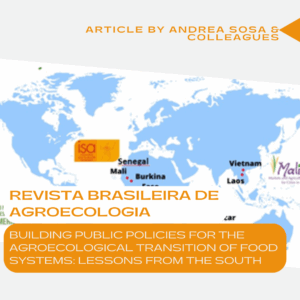
Building public policies for the agroecological transition of food systems: Lessons from the south

Posted on July 21, 2025July 14, 2025 by CASAS

Andrea Sosa, CASAS’ member, has published this article with Eric Sabourin, Carolina Milhorance, María Mercedes Patrouilleau, Stéphane Guéneau, Paulo Niederle, Claire Dedieu, Catia Grisa, Jean-François Le Coq and Sara Mercandalli in Revista Brasileira de Agroecologia.

Abstract: This article presents the results of the first stage of the TAFS project (Agroecological transitions for sustainable food systems: a case for public policies) coordinated by the Centre for International Cooperation in Agricultural Research for Development (CIRAD) and carried out by various partners in ten countries in Africa, Latin America and Asia. The main objective of the TAFS project was to provide decision-makers with convincing arguments for the formulation and construction of public policies to support the Agro-Ecological Transition (AET) of food systems at the territorial scale. The project also drew on this knowledge to stimulate collective reflection on public action instruments and to co-construct, with decision-makers and territorial food system actors, a strategic vision of the transition to sustainable food systems based on agroecological practices. The results are based on scientific evidence, field data and practical experiences. They highlight three main conclusions: i) the diversity of definitions and visions of the Agro-Ecological Transition with a series of conceptions hybridizing three categories: Agroecology, organic production and sustainable agriculture; ii) the variety of actors involved in the formulation of agro-ecological transition policies, but the key role of the actor translating the implemented concept: social movements or international cooperation agencies; iii) the AET institutionalization processes are marked by dialogues between these two categories of actors and public authorities and shaped by the political regime and/or the international cooperation system.

Read the full article: https://doi.org/10.33240/rba.v20i2.56895

Follow us on our social media
  • Facebook
  • Twitter
  • Instagram

Share this:

  • Share on X (Opens in new window) X
  • Share on Facebook (Opens in new window) Facebook
  • Share on LinkedIn (Opens in new window) LinkedIn
  • Print (Opens in new window) Print

Like this:

Like Loading…

CASAS

Avatar photo

The Collective of Agrarian Scholar-Activists from the Global South (CASAS) is a community of Scholar-Activists working in critical agrarian studies.

Leave a ReplyCancel reply

RECENT POSTS

  • Paguyuban Petani Lahan Pantai Opposing the Neoliberal Policy in the Kulon Progo Coastal Area
  • Movimentos agrários e a luta pela transformação agroalimentar na África Austral
  • Looking back to move forward: historical Agroecology and reciprocity in Ecuador and Bolivia
  • Reproducing Operational Landscapes: The Rock Mining for Indonesia’s New Capital City
  • Private Land Ownership, Race and Class Consideration (1964-1985)

CATEGORIES

  • CASAS Members
  • CASAS' members publications
  • Conferences
  • Insights from the ground
  • JPS Food Sovereignty
  • JPS Writeshop
  • Multimedia
  • News
  • Special Issues
  • Who is who in CASAS?

ARCHIVES

  • June 2026
  • May 2026
  • April 2026
  • March 2026
  • February 2026
  • January 2026
  • December 2025
  • November 2025
  • October 2025
  • September 2025
  • August 2025
  • July 2025
  • June 2025
  • May 2025
  • April 2025
  • March 2025
  • February 2025
  • January 2025
  • December 2024
  • November 2024
  • October 2024
  • September 2024
  • August 2024
  • July 2024
  • June 2024
  • May 2024
  • April 2024
  • March 2024
  • February 2024
  • January 2024
  • December 2023
  • November 2023
  • October 2023
  • September 2023
  • August 2023
  • July 2023
  • May 2023
  • April 2023
  • March 2023
  • February 2023
  • January 2023
  • December 2022
  • November 2022
  • October 2022
  • September 2022
  • August 2022
  • May 2022
  • February 2022
  • July 2021
  • April 2021
  • March 2021
  • February 2021
  • January 2021
  • December 2020
  • November 2020
  • October 2020
  • August 2020
  • July 2020
  • June 2020
  • May 2020
  • April 2020

RECENT COMMENTS

  1. Mercedes Ejarque on Call for applicants: Writeshop 2026
  2. shemilkalayath on Call for applicants: Writeshop 2026
  3. Why Palestine is a feminist and an anti-colonial issue  | ROAPE on Palestine: Reaffirming our commitment for a solidarity-based network of agrarian studies global-south scholars
  4. Mercedes Ejarque on Call for applicants: Writeshop 2026
  5. tranquil865a3fc7cd on Call for applicants: Writeshop 2026

TAGS

Africa Agrarian Change agribusiness agriculture Agroecology Argentina Asia authoritarianism Bolivia Brazil Chile China climate change COHD Colombia conflict COVID-19 Critical Agrarian Studies Development Studies Ecuador Extractivism food sovereignty gender Global South India Indonesia JPS land rush Latin-america mexico Middle East Mozambique pandemic pastoralism scholar-activism Social Movements social reproduction South Africa South America sustainability Turkey Violence vulnerability writeshop Zimbabwe

CONNECT WITH CASAS

RSSTwitterFacebookLinkedin

SUSCRIBE BY EMAIL

CASAS SOUTH FACEBOOK

Tweets by Casas_South

Meta

  • Log in
  • Entries feed
  • Comments feed
  • WordPress.org
©2026 Collective of Agrarian Scholar-Activists from the South | Built using WordPress and Responsive Blogily theme by Superb
%d